The Heiress, the Heist, and Me: A Bel-Air Fairytale | Vanity Fair
In Los Angeles, the night of Friday, December 8, 1961, was appropriately dark and stormy. A tree was downed on Bel Air Road, causing a man on a scooter to crash as he raced around a steep corner. A member of the Bel-Air Patrol later came by to discover the accident and the dazed man on the ground. He helped him up, handed back the white pillow sash he’d been carrying, and, without curiosity or question, sent him on his way.
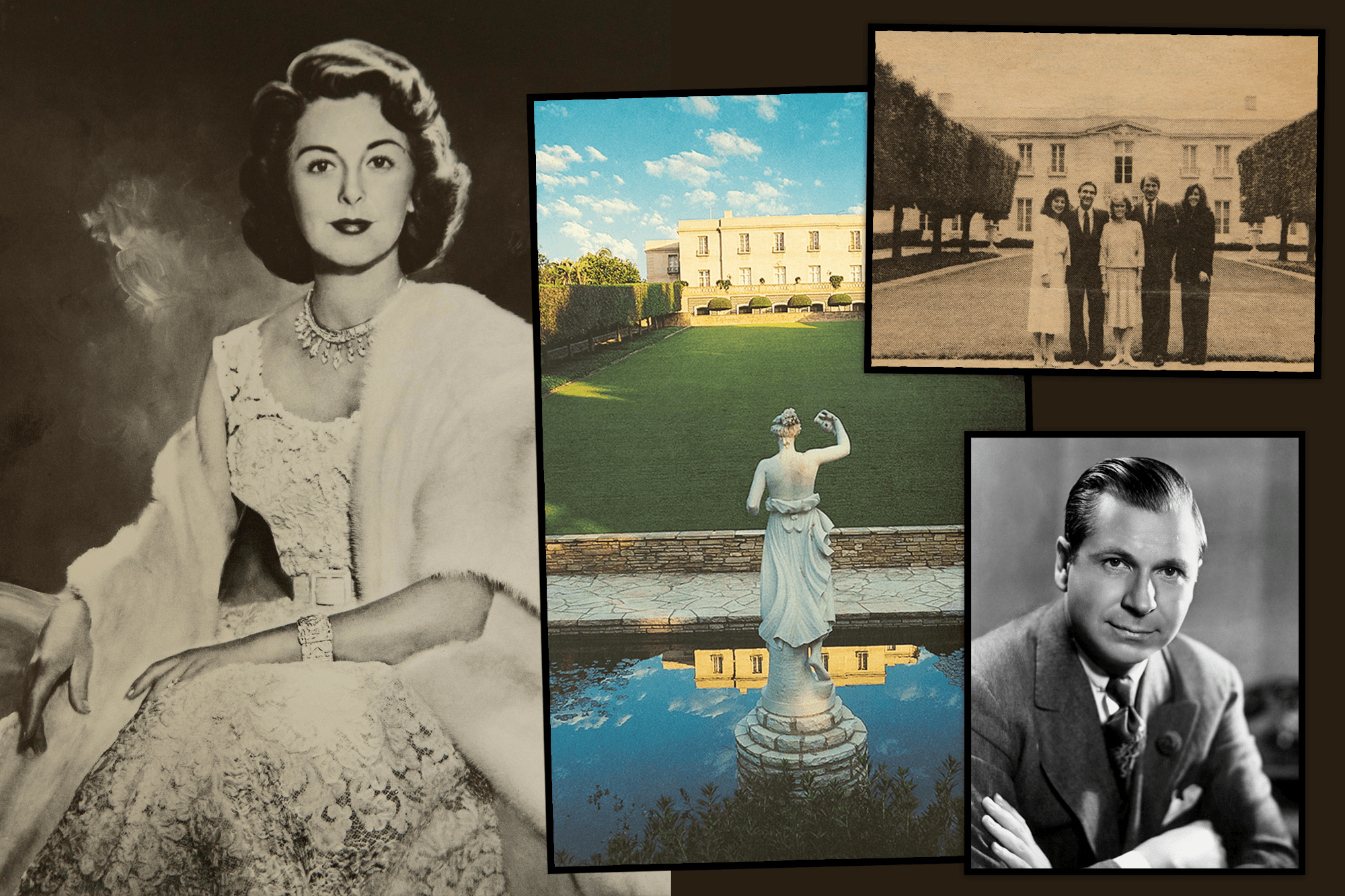
Meanwhile, 15-year-old Carla Kirkeby was home alone—aside from her family’s sleeping staff—in their approximately 22,000-square-foot residence at 750 Bel Air Road. If the address sounds familiar, it’s because the house’s grand limestone facade, originally designed by architect Sumner Spaulding, was used for exterior shots in the hit ’60s sitcom The Beverly Hillbillies. Once referred to as “the house of the golden doorknobs,” the 10-acre estate, also known as Chartwell, is currently owned by Lachlan Murdoch; he bought it in 2019 for $150 million.
Carla’s parents—Arnold Kirkeby, the prominent Beverly Wilshire hotelier and renowned art collector, and Carlotta Cuesta Kirkeby, a philanthropist, socialite, and daughter of Cuesta-Rey Cigar cofounder Angel LaMadrid Cuesta Sr.—were at a dinner party in Palm Springs that night. While they were out, Carla would discover that all of her mother’s jewels—worth around $320,000 at the time, with an estimated value of $3 million in today’s dollars—had vanished. The robbery would later be connected to a smaller cache of precious gems that had gone missing the previous month from the Beverly Hills home of real estate developer Paul Trousdale, a close friend of the Kirkebys—making these twin burglaries among the largest heists in Los Angeles history.
Finding the perpetrators would take months and raise questions that hit uncomfortably close to home—not only the Kirkeby’s home, but also mine.
Carla had a brother: Arnold C. Kirkeby, who was 17 years older than her and aptly nicknamed “Buzz”—a many-times-married alcoholic and constant source of trouble for their parents. Buzz dabbled in several businesses, including a catering company, which, according to Carla, was disastrously inept that he co-owned with a man named George Dordigan, a gregarious and disarmingly handsome Ricardo Montalban lookalike. George felt most at home in the ocean—deep-sea fishing and free-diving for lobster off the California coast—but he also loved horse racing and gambling; some of his cronies at the track told me he wasn’t above fixing a race. He was the kept man of a wealthy doctor, which allowed him to maintain a lavish lifestyle and gave him an inflated sense of himself.
As the investigation unfolded through the spring of 1962, newspaper headlines implied that George may have been involved in the jewel heist. George also happens to be my grandfather.
Six decades later, in October 2025—after learning the truth about George’s role in the robbery, and writing an article titled “My Grandfather the Jewel Thief”—I received a message: “Hi, Jennifer. I just read your article and was hoping to talk to you. My name is Carla Kirkeby, and I was 15 when this happened. Please reach out to me as I am interested to share what I remember from the incident. I have a whole different take on the robbery.”
Carla is now 80 years old. We first meet in late October 2025: She’s sharp and put together in a dusty pink pinstripe button-down and matching pants—both from Alo—living in a four-story Bel-Air–adjacent condo she calls “kind of a dump.” The “dump” is filled with tasteful art. An assortment of small African sculptures line built-in bookshelves that flank a fireplace. Tucked between the second and third-floor staircases is a life-size statue of a nude woman leaning forward, her elbows resting on a pedestal displaying a bronze bust of the same statue. When I ask about it, Carla laughs. “Oh, that’s Julia, I’ll tell you all about her later.” The piece, by American artist John De Andrea, was valued at more than $110,000 in 1974.
Carla says that her father largely inspired her love of art. Arnold had an extensive collection that included many of the masters—Modigliani, Monet, Manet, Renoir, and Cezanne. “When I was around 10, I was mad that I didn’t get the same kind of allowance my friends did. So my father told me if I learned something about each of the paintings, he’d pay me,” she says. “And then, when he’d have a business associate visiting, I’d give tours.”
Carla was just a toddler when Arnold moved the family from Chicago to Bel-Air, after his friend, dam and pioneering California highway builder Lynn Atkinson, defaulted on a personal loan from Kirkeby he’d taken to finish the dream home Atkinson had built for his wife. Now, the Kirkebys would live in the elaborate estate. Carla says her mother wasn’t thrilled about inhabiting the swanky home now known as “the Beverly Hillibillies house.” Carlotta felt the house was too big and extravagant. (Even though the home had been built for her, Atkinson’s wife had expressed a similar sentiment.) Nevertheless, the Kirkebys settled in and hired a nine-person staff, six of whom lived in the house. Carla says she wanted to learn to cook, but their chef—a 6-foot-tall Dane named Ida who served the family for over 40 years—barred her from the kitchen.
Carla’s childhood reads like a transient fairytale. Though they were based in LA, her family also flitted between homes in Florida, New York, and Cuba, where Arnold owned the Hotel Nacional, which hosted the infamous mafia “Havana Conference” in 1946. At the age of five, her name was already appearing in the society pages of newspapers. Carla attended Westlake School for Girls (which later merged with the Harvard School for Boys to form Harvard-Westlake) with Hollywood notables like Candice “Candy” Bergen. As a junior, Carla transferred to University High School Charter, a.k.a. “Uni,” in West LA. Beverly Hillbillies fans were constantly swarming the Kirkeby home: “We’d look out the window and see people picnicking on our lawn,” she says. Strangers came knocking, looking for the Clampetts. She fondly remembers Max Baer Jr., the actor who played Jethro in the series, occasionally napping on their sofa.
Discovering a historic jewel heist might easily be the most interesting thing to happen to most people. But the captivating details of Carla’s life threaten to reduce it to a footnote. At 14, she threw a wild rager that ended after a partygoer made off with one of her parents’ prized Christmas presents: a silver platter engraved “to Arnold and Carlotta, from Ron and Nancy.” (The Reagans were the Kirkebys’ next-door neighbors and friends.) At 23, police stopped her for going over 100 miles per hour down the Pacific Coast Highway in a Ferrari 275 GTB4—the same make and model as a missing car that belonged to Sharon Tate, who had recently been murdered by Charles Manson’s followers. She says she once wrested her mother from the notorious clutches of John Paul Getty after what she described as “a mediocre dinner” at the magnate’s Surrey estate. On another England adventure, she strolled into a chauffeured Rolls-Royce in London to find herself face-to-face with a young Mick Jagger. Angelina Jolie’s mother was her children’s babysitter.
Still, the robbery stands out, even to this day. On that fateful night in early December 1961, Carla’s parents were, as usual, at a party. They were still gone when Carla came home around 10:30 p.m. “I went upstairs to my mother’s room to get a magazine,” she says, “and saw all of her jewelry boxes on the floor, in a perfect row.” Though they weren’t in disarray, Carla still knew something was wrong: Her fastidious mother would never have left out the boxes, which were normally kept behind a hidden wall panel so secret that no one outside of her immediate family even knew it was there. She opened each box and found it empty, confirming her suspicion.
A frightened Carla wondered if the thieves were still in the house, possibly hiding in her mother’s darkened dressing area. She tore down the back stairs—three stories—to Ida’s room, where she called the police. Doris and Ann, the family’s longtime upstairs-downstairs maids, were there too. And just as the police arrived, Carla’s parents came home.
Carla remembers that her mother was relieved she’d been wearing the 24-carat marquise-shaped diamond ring Arnold had given her for their anniversary; Carla herself was a little embarrassed by the ring and the attention it brought when people noticed it in public. (When they went to a movie and were being shown to their seats, Carlotta’s “everyday” ring would, intentionally or not, catch the usher’s light, showing off its brilliance and eliciting gasps.) After Carlotta died in 1986, Sotheby’s would sell the Kirkeby diamond for $616,000 to a European dealer, whose Brazilian client fell in love with a portrait of Carlotta.
News of the robberies spread nationally: “$250,000 Jewel Burglary Spurs Police Manhunt,” read one headline. “$350,000 Jewel Theft at Bel-Air Home of Kirkeby,” blared another. Carla says her parents had no idea who might be behind the robberies and were surprised the thieves had ignored the millions of dollars’ worth of paintings. There would be no break in the case until April 1962.
Now it’s my turn to explain that in the early ’90s, my grandfather told me a crazy story about hiding some jewels in a beach cave. I didn’t ask questions, chalking it up to another of his wild adventures. I had no idea the magnitude of the secret I’d uncovered until I brought up the story to my great aunt, his sister, after he died in 2011—and she told me he’d stolen the jewels. After years of extensive research, I learned that my grandfather planned the carefully executed robberies, enlisting the help of his brother-in-law, Elbert Houghton, and a friend of theirs, Francis “Kiha” Kinney, who was known for being a safe cracker. Though the link between them hasn’t been proven, it seems likely that Buzz—intentionally or not—helped the crew get into the Kirkeby home and make off with the loot.
I ask Carla what she thinks about the heist being an inside job—because that’s what I’ve been told, and the connection between Buzz and George raises more than a few questions. She acknowledges her brother was “drunk all the time” and, while not trying to defend him, she thinks he could’ve been an unwitting pawn in George’s scheme.
I can understand the theory. The robberies at the Trousdale and Kirkeby homes occurred almost exactly one month apart, on November 2 and December 8 in 1961, respectively. By April of 1962, police had traced George and his two accomplices to a motel in San Francisco, after George purportedly called Buzz with an offer to return the jewels for $75,000. There, the trio was arrested.
Back at home, though, Carla witnessed something markedly different. She distinctly remembers a member of the West LA police department coming to the Kirkeby home with a “sleazy lawyer” and an ultimatum saying, “We want $75,000, or we’re going to say that Buzz orchestrated this robbery.” I ask if she thinks her mother paid them. Carla doesn’t know for sure, but she assumes Carlotta did—because even after the arrests, Buzz’s name was kept almost entirely out of the papers.
Carla remembers testifying against Kinney in court. “He had the tiniest hands—and that’s why he was able to squeeze his way into the sliding door in the back of the house. That house was so easy to break into.” Kinney was also the guy who crashed his scooter while carrying that white pillow sash—ostensibly filled with Mrs. Kirkeby’s jewelry. Initial charges against both Kinney and Houghton were dropped early in the investigation as authorities narrowed their focus on George.
Most of the jewels were recovered in May 1962, after George led an LA Police detective to my great-grandmother Martha’s house. Unbeknownst to her, the loot had been stashed in her attic crawl space. Yet that cache was incomplete: approximately $500,000 worth of jewels in today’s dollars have never been found.
According to Houghton, George was “in” with the cops. Given Carla’s version of events and the outcome of the case, that certainly seems plausible. At a subsequent sentencing in Santa Monica Superior Court, the most serious charges against George—two counts of grand theft and two counts of burglary—were mysteriously dismissed. (He was convicted of receiving stolen property.)
The saga unfolded as Carla and Carlotta grieved an unrelated loss. Arnold had been aboard an American Airlines flight on March 1, 1962, when the plane crashed into Jamaica Bay, Queens. He was among the 95 passengers and crew who perished in the accident. Carla had a complicated relationship with her father; the business of owning hotels meant he was almost never home, and she says he “didn’t seem that fun.” As the Havana Conference implies, he may have also had ties to the mob—a 1977 Miami Herald story included Arnold in a “cast of characters” that also featured notorious gangsters Meyer Lansky and Bugsy Siegel—though it’s obviously a delicate subject. Carla believes that connected men approached her father about developing hotels in Las Vegas, but he refused their offer: “My father said he never wanted to get in with those guys,” she says, “because once you’re in, you can’t get out.”
Carla still has endless tales to tell. She shares even more on Valentine’s Day, when we meet for dinner at the Golden Bull in Santa Monica with Francesca Keck, adopted daughter of Superior Oil heir Howard B. Keck. “Frandy” is Carla’s oldest and closest friend. As we sip our drinks (dirty martini for me, Chardonnay with ice for Carla), Francesca’s sure I’m secretly recording the conversation. We discuss my charming but nefarious Armenian grandfather. I show them a photo: “Oh, yes. He looks fun.” Francesca says, smiling. Carla agrees.
Carla and I lament the questions we’ll never be able to answer: about jewels never found, or how Buzz and George came to be friends. (Since they both loved betting on the ponies, we agree that they likely met at the track.) I tell Carla how, in life, my grandfather was always trying to introduce me to people he thought I should know or could learn from—“stick with winners,” he’d say. And so, here we are.
Kiss Kiss Bang Bang: Glock’s Wild Succession Saga
All the Drama Surrounding The Drama, Explained
The Saga That Sent the Chess World Spinning
A Complete List of Meghan and Harry’s Creative Projects
The High-Stakes Gambler, and Self-Styled Vigilante, at the Center of Paramount’s Legal Drama
Exclusive: Lindsey Vonn on Life After Her Horrifying Crash
The Water Polo Scandal That Rocked LA’s Most Elite Private School
Kylie Jenner Enters Her Hollywood Era
From the Archive: What Really Happened the Night of Joey Comunale’s Murder