King Charles' Visit Highlights Trump's Royal Aspirations | Vanity Fair
When Prince Charles visited the United States in 1981, New York magazine reported that “aides” to the royal family met with Donald Trump to discuss the purchase of a $5 million apartment in his new building, Trump Tower. A palace spokesperson briskly shot down the report, calling it “completely untrue.” No matter. Stories suggesting royal interest in Trump’s properties cropped up frequently during the 1980s and 1990s, generating a lot of publicity for the young developer and his new skyscraper in Manhattan—even as the palace denied them every time.
When Trump was asked about the reports, he couldn’t help but revel in the implication. A decade after the New York magazine story, the New York Post published another “rumor”—one it confessed was “maybe started by the Trump Organization”—that Princess Diana was looking to buy an apartment in Trump Tower.
“That’s true,” Trump said when asked about the story in an interview. He then mused about dating the princess. “She is really hot. She has gained 20-25 pounds, she looks great. There could be a love interest. I’d become King of England. King of England.”
Read Party Animals: A letter from the back rooms, barstools, and bacchanals of Washington, DC—with exclusive reporting, interviews, and analysis.
Diana never bought an apartment in Trump Tower, and despite his reported efforts behind the scenes to lure her to one of his parties, Trump never became King of England.
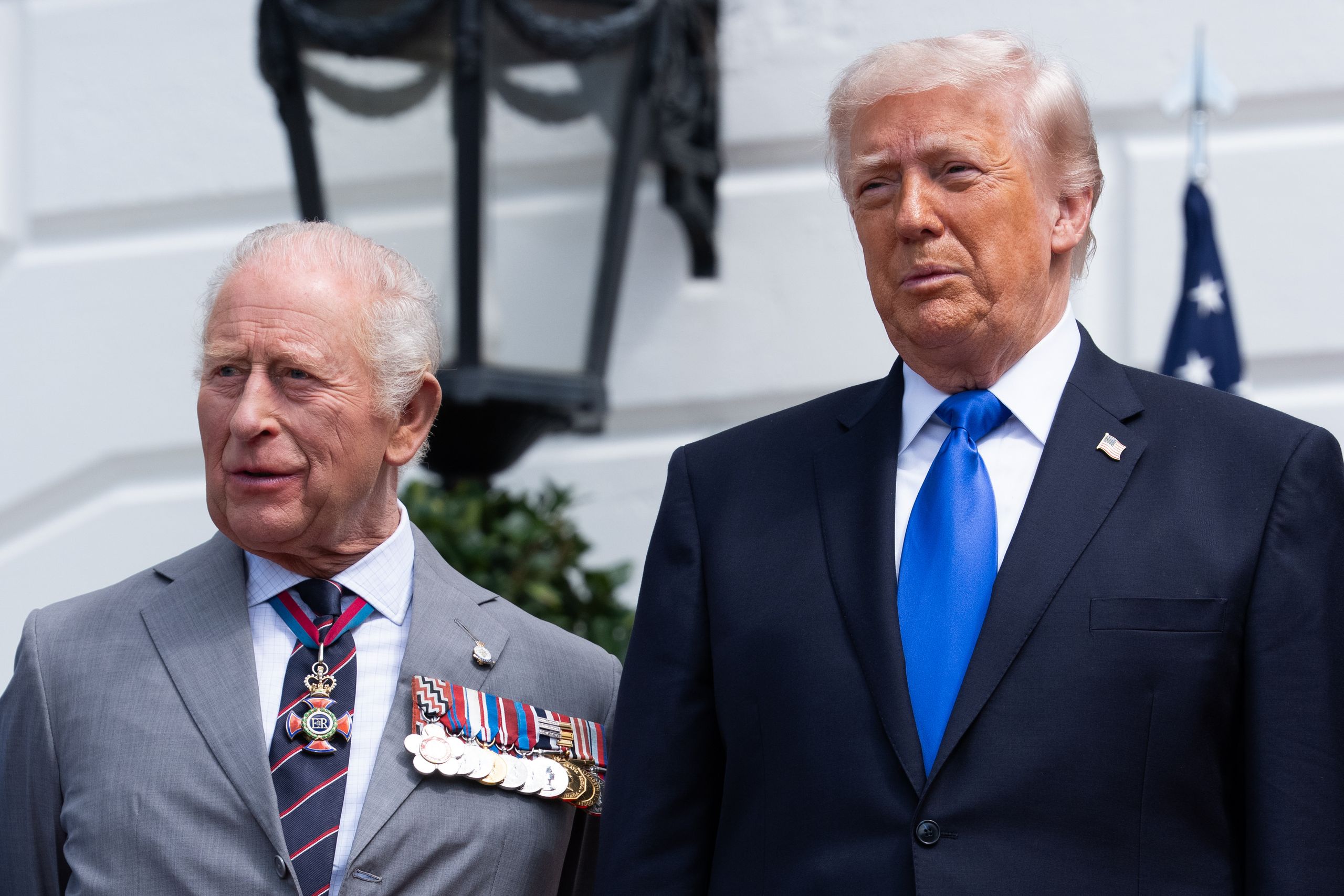
He did become president, and his infatuation with the royals has revived their relevance in global diplomacy. This week, in close coordination with 10 Downing Street, King Charles III visited Trump in Washington for several days of pageantry that included a tour of a White House beehive, an address before Congress, and a state dinner during which gifts were exchanged and jokes cracked about the 250th anniversary of American independence from Great Britain.
There are hopes that the visit will soothe tensions between the two countries. Given Trump’s infatuation with the crown and personal admiration for the current king, the old empire might have a fighting chance. Even after Charles delivered an address to Congress that implicitly refuted some core tenets of Trumpism—there was an ode to limits on executive power, a defense of NATO and Ukraine, a rousing call to protect the natural world—Trump raved about it ahead of the state dinner that night. “He made a great speech,” the president said. “I was very jealous.”
While I watched from the mezzanine as the king spoke before Congress, commending the United States for its system of checks and balances, the White House posted a photo of Trump alongside Charles with the caption: “TWO KINGS.”
It’s a tale as old as empires. A century before American independence, King Charles II spent nearly a decade in exile after his father was deposed and executed in 1649. He fled to the Isles of Scilly off the coast of Cornwall and eventually to France and the Spanish Netherlands. But England’s fragile new republic did not hold. In 1660, Charles returned to England to be restored as king.
Trump faced his own banishment to Mar-a-Lago after leaving the White House in disgrace in 2021. Just four years later, he would storm back to power, and the pain of his exile has shaped much of what he’s done this term. As if in a hurry to leave his mark on Washington and the world, Trump has spent the last year working on projects he hopes will outlast his presidency: Demolishing the East Wing of the White House to build a giant ballroom, launching a regime-change war with Iran, musing about annexing Canada and Greenland as part of an imperialist campaign to drastically expand the borders of the United States. One suspects that if he could rename the country after himself, he would.
The king and the president had a grand old time in gilded environs.
“I think he would love to be King Donald I more than life itself,” says Piers Morgan, who has known Trump for years and spoken to him frequently about the royal family. “Partly for the aesthetics, partly to hear people have to call him that, but also because I think he finds the constraints of democracy rather limiting.”
It’s all a way of “padding his ego” after the “scar tissue” left by the 2020 loss, one Trump confidant tells me. “He has a fixation on delivering historic acts, whether starting a foreign war or replacing a Fed chairman because he didn’t move monetary policy in the direction Trump approved of. That forces history to carve his name deeper than his predecessors.”
David Axelrod is fond of pointing out how curious it is for the United States to celebrate its 250th year of independence from a mad king while under the stewardship of a president who wishes to be one. Trump has stretched the limits of executive power further than any president in modern history. Just this week, Trump’s administration announced new charges against enemy-of-the-crown James Comey, the former FBI director whom Trump has pressured his Justice Department to go after. (Andrew McCarthy, a Fox News legal analyst, called the prosecution “grotesque,” “absurd,” and “bogus.”)
“I think he would love to be King Donald I more than life itself.”
But it’s the ornamental qualities of the monarchy Trump seems to prize the most. He’s festooned the White House in gilded accents that give it the look of an Atlantic City Versailles. He slapped his name on the Kennedy Center and the Institute of Peace. His lieutenants have draped large banners of his face from government buildings across Washington. As we first reported here a few weeks ago, he’s putting his name on US currency. This week it was reported that he’s putting his face on some American passports.
Like the Emperor Napoleon, who commissioned the Arc de Triomphe in Paris after his victory at Austerlitz, Trump has proposed the construction of his own 250-foot arch in the capital. Napoleon at least had the humility to build the monument with national pride in mind. When a reporter asked our president who or what the arch was for, Trump replied: “Me.”
Trump unveils the Arc de Trump.
“He came back determined not just to govern, but to stamp ‘Trump’ on anything and everything he could think of,” the confidant explains. “Trump doesn’t see Washington as a city to manage the government, he sees it as a media studio to reshape the country in his image. You think it’s a coincidence that his inner circle resembles a Fox News green room? There’s also a monarchy instinct there: monuments, arcs, highways, airports, and libraries renamed ‘Trump.’ Even with US currency and passports, he now wants his own image plastered front and center.”
It is no coincidence then that Trump so admires a family that bears all of the trappings of imperial power with none of the actual force of it. The royal family reigns, it does not rule. Trump, one suspects, would be just as happy as a ceremonial leader, receiving heads of state at his gilded White House and exchanging gifts as the cameras fluttered and reporters shouted questions about new renovations to the Lincoln bathroom.
When a reporter asked our president who or what the arch was for, Trump replied: “Me.”
During the king’s visit to the White House on Tuesday, the Marine band performed as Trump and Charles were guided around the South Lawn. Trump bobbed around pleasantly, grinning and patting his thigh to the music. At the state dinner, Charles presented Trump with a gift: a large golden bell bearing Trump’s name, which hung from a British submarine called the HMS Trump in 1944.
You couldn’t have invented a better gift for the current president. Gold, with Trump’s name etched in giant letters, implying his own special place in wartime history. Trump beamed with delight. No matter that the war Trump is actually waging in Iran has quickly devolved into a bloody quagmire, killing thousands, costing the United States billions of dollars, and threatening to plunge the global economy into recession. Trump has his wartime bell.
The president was gifted another treat this week to flatter his lifelong admiration for the monarchy. The Daily Mail reported at the start of Charles’s visit that Trump might be a distant cousin of the king. This wouldn’t be entirely surprising—it is believed that millions of Britons have some ancestral connection to the royals—but Trump treasured the news. “Wow, that’s nice,” he wrote on Truth Social. “I’ve always wanted to live in Buckingham Palace!”
Inside the Enhanced Games—Where Athletes Biohack Their Way to Glory
Trinidad Chambliss on Why He’s Doing Battle With the NCAA
All the Details From Trump’s State Dinner
See the Royal State Visit In Photos
Nick Reiner and the Making of a Modern Hollywood Tragedy
The First Time America Has Seen Melania Trump Visibly Emote
The Unholy Guide to Looksmaxxing
Inside the Tony Dokoupil Era at CBS
Why Is Janet Jackson Missing From Michael?
From the Archive: Meryl Streep’s Hollywood Revolution