The Mystery Buyer of the $181 Million Pollock at Christie’s $1.1 Billion Auction | Vanity Fair
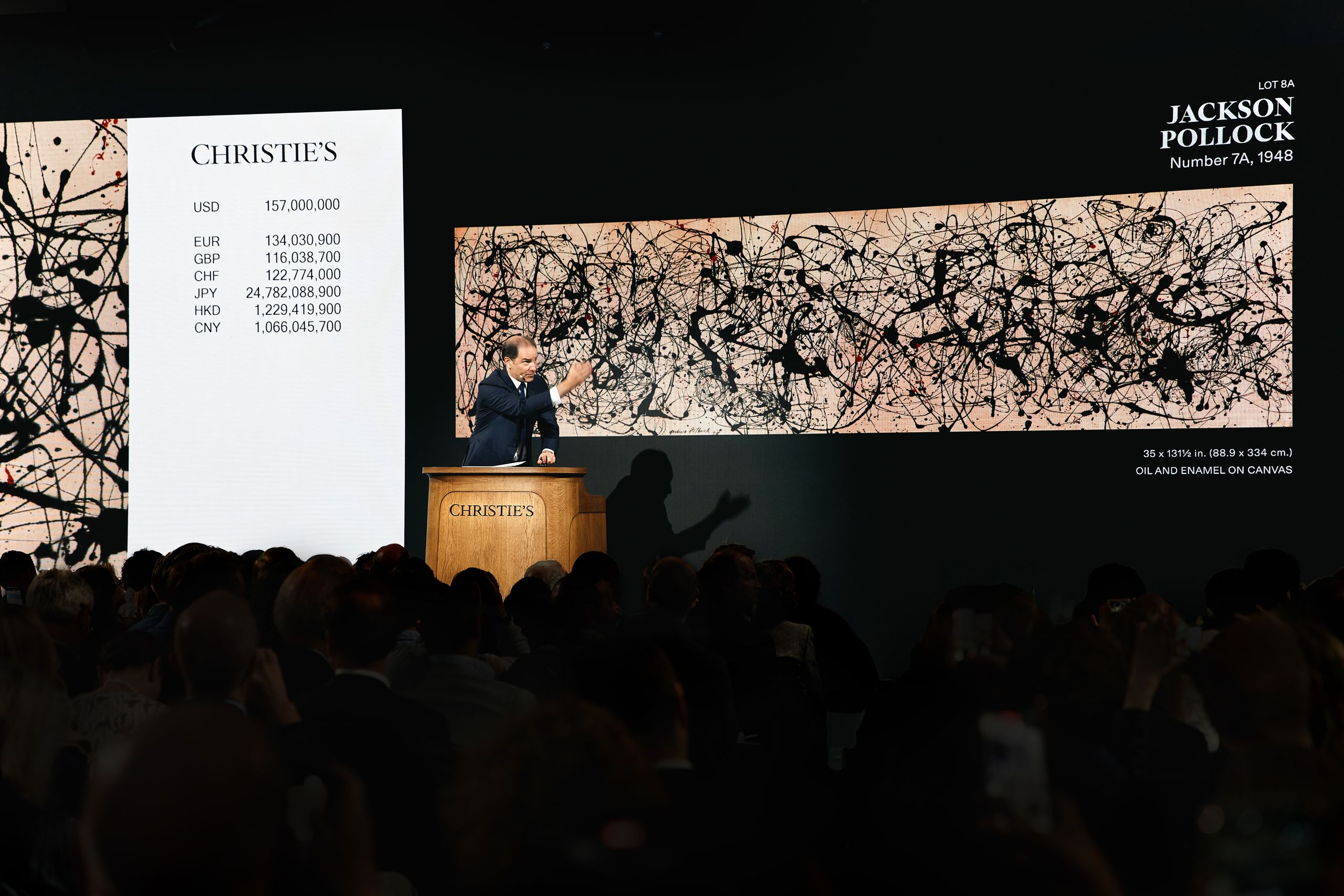
On Monday night just before 7 p.m. at Rockefeller Center, in the middle of Manhattan, that rare opportunity presented itself—for a very select few. It’d been decades since a Jackson Pollock drip painting last came to market, and now, there was one for the taking at Christie’s. Number 7A, 1948, an 11-foot-long drip, impossible to find. It was part of the Si Newhouse collection, an extensive trove of modern art put together by the late Condé Nast chairman.
It was just the start of a highly anticipated auction that racked up $1.1 billion in total sales in less than three hours, a remarkable figure that may firmly end the multiyear downturn in the art market.
Even though there are only so many people in the world who can buy a piece of art with bids that start at $82 million, the billionaires showed up, and kept on bidding.
“Lot number eight, ladies and gentlemen: the Jackson Pollock, the monument of modern art. The largest drip in private hands ever to be offered at auction, for the first time, at the public market,” said auctioneer Adrien Meyer, standing on the rostrum.
Or, as Tobias Meyer, who was appointed adviser to the Si Newhouse estate (and is not related to Adrien Meyer) told me last month, “If you’re serious about painting, and if you’re serious about 20th-century art, this is your painting.”
“It’s just a question of: Are you rich enough or not?” he said.
At first there were three collectors all willing to pay, including one on the telephone with Alex Rotter—that bidder went to $102 million, ahead of the other two jousting for primacy. Rarefied air, money only so few can spend. Suddenly another bid came from someone sitting in the room and everyone swiveled their heads to catch a glimpse of the brave paddle-waver. It was Iwan Wirth, the founder of the global mega-gallery Hauser & Wirth, an unusual presence at the New York evening sales.
He was about to make his presence felt. For the next five minutes, Rotter watched as each one of his $1 million increases in price were bested by Wirth, who nodded as quickly as Meyer could face him, occasionally whispering to his wife, Hauser & Wirth co-founder Manuela Wirth. It was a shocking spree of potential wealth disbursement on display. The number went up by a million again and again, the leading bid whipsawing back and forth, leaving Meyer nearly out of breath and swiveling his torso between the two.
“One-forty-five”—turn—“One-forty-six”—turn—“One-forty-seven”—turn—“One-forty-eight,” Meyer rattled off.
After much of this it landed on Rotter, and his bidder’s number of $153 million, a figure that ended the back-and-forth with Wirth.
But then, out of nowhere, Ana Maria Celis came in at $154 million, pushing the bidding higher. Rotter returned with $155 million, Celis came back with $156 million, to which Rotter responded with $157 million. There it hammered, to grand applause. With fees, the price was nearly $181.2 million, the most expensive artwork sold in years.
After the smoke cleared, multiple sources had theories about who was on the phone with Rotter. Leading up to the sale, I asked a number of high-profile advisers with clients who can actually afford the Pollock who might be bidding on it. The consensus pick: It would be an American, and it would not be someone new to this kind of art-buying.
Some speculated prior to the sale that a potential bidder could be Ken Griffin. His collection is beyond remarkable. A few years ago, I reported on Griffin moving his private collection from the Art Institute of Chicago, quietly, without any press release or announcement—to the Norton Museum of Art in Palm Beach. There’s Willem de Kooning’s Interchange, Mark Rothko’s No. 2 (Blue, Red, and Green) (Yellow, Red, Blue on Blue), and Roy Lichtenstein’s Ohhh...Alright…. He already has a Pollock in his collection, and a good one: Number 17A, which he bought from David Geffen in 2016 for $200 million. But sources told me that Griffin was not the bidder on the phone with Rotter.
Another potential buyer, who has purchased work at Christie’s evening sales in the past, is Jeff Bezos. And yet, sources indicated that Bezos was not bidding on the Pollock.
A few lots before the Pollock, a sculpture by Constantin Brâncuși sold for $102 million, making it the second-highest price ever paid for a sculpture. The hammer price was $93 million, secured by Christie’s specialist Maria Los. Later, a work by Mark Rothko from the collection of New York’s grand dame philanthropist Agnes Gund sold for $98.4 million, a record for Rothko, the great brooding abstractionist of the 20th century.
Those two sales amount for new auction records, and mind-boggling amounts of capital expended on culture. What’s remarkable is how, in the room, things felt a bit anticlimactic. For the Brâncuși, Christie’s had brought in a secret weapon: Oscar-winning actor Nicole Kidman. In a spectacle orchestrated by Tobias Meyer, Kidman was chosen because she bore a striking resemblance to the model for Brâncuși’s Danaïde, and she danced around the sculpture in its specially designed cupola. But it’s not clear the marketing moved the needle. In the room, it appeared that the winning bid was placed on behalf of the third-party guarantor, following a series of chandelier bids from Adrien Meyer—meaning that the prearranged price offered ended up being the final hammer.
(Reports leading up to the sale indicated that the entire Newhouse collection was guaranteed by the same collector. I asked one source, a former Christie’s specialist, if it was the house’s owner, François Pinault. They said that was unlikely.)
Sources struggled to initially pinpoint who guaranteed, and then bought, the Brâncuși. When asked on Tuesday, one source guessed it could be a certain New York-based hedge fund billionaire. Los works with a number of clients across the Americas, most of them privately, through the client services division. Similarly, we don’t know who purchased the Rothko, which was bought by Rachael White Young, head of the postwar evening sale, on behalf of a client, for an $85 million hammer price.
There was also much speculation about the identity of the client bidding through Wirth, who may not have won the painting but did a remarkable job going toe-to-toe with Rotter. Some speculated it could be Laurene Powell Jobs, who has bid through Wirth in the past and is known to have an adviser-advisee relationship with the gallerist. But others hastened to add that Wirth, of course, has a number of clients who could be bidding at that level.
Whoever it was didn’t go home empty-handed. A few lots later, Wirth was the winning bidder on Jasper Johns’s Gray Target, for a hammer price of $24.5 million, or $28.8 million with fees.
The scene at Rock Center—before, during, and after the first billion-dollar single-night auction in years—was electric.
“This is a big, big night for you, Tobias,” Jeanne Greenberg Rohatyn (who just walked in the Gucci show in Times Square) said to Tobias Meyer and his husband, Mark Fletcher, before the sale started. Then she took her seat in a sales room that held within its tight confines nearly every important secondary market dealer and adviser in New York. I spotted the Nahmad family; Tico and David Mugrabi; Thaddaeus Ropac, who stayed until the end to bid on and win a Duchamp; former Christie’s rainmaker Jussi Pylkkänen; adviser Sandy Heller; Amalia Dayan, Brett Gorvy, and Dominique Lévy of their eponymous gallery; a team from Gagosian Gallery; Per Skarstedt; Christophe van de Weghe; and so many others.
Midway through the 20th-century sale, which followed the suite of Newhouse offerings, some dealers started streaming out of the room as the proceedings approached the three-hour mark. As I was leaving, I caught up with Jeffrey Deitch, who successfully bought two works Monday night on behalf of clients, both once Newhouse’s: Johns’s Alley Oop and Andy Warhol’s Do It Yourself (Violin). As we walked out, we passed another Warhol that had sold that evening: Double Elvis [Ferus Type] which hammered at $23 million, well below the low estimate, or $27.1 million with fees.
It was being sold by the Fertitta brothers, the Las Vegas casino magnates and onetime owners of UFC who purchased this particular Warhol just a few years back…for $37 million, meaning they took a loss on the transactions. They had installed the work in their off-Strip casino, The Palms. When they first opened it following extensive renovations, Deitch remembered, with great fondness, seeing Double Elvis when he walked to the lobby.
“This is as good as it gets when it comes to Warhol,” Deitch said. He sighed, perhaps at the too-low price for such a great Warhol, perhaps at the fact that its new owner will probably not install it in a casino in Vegas for all to see, and then walked out of Christie’s.
Have a tip? Drop me a line at [email protected]. And make sure you subscribe to True Colors to receive Nate Freeman’s art-world dispatch in your inbox every week.
Anna Paulina Luna Is on a Mission to Reveal the Government’s Biggest Secrets
Who Will Be the Next James Bond?
Stars Share Their Favorite Stephen Colbert Stories
Live Updates From the 2026 Cannes Film Festival
See All the Fashion From the 2026 Cannes Film Festival
Carlos Alcaraz on “Living the Dream Life” and His Rivalry With Jannik Sinner
A’ja Wilson Is Going for GOAT Status
Kylian Mbappé Is Scoring All the Goals—and Taking All the Heat
Audrey Hepburn’s Remarkably Resilient Life
10 Undeniable Facts About the Michael Jackson Sexual-Abuse Allegations
From the Archive: Stephen Colbert on Trump Trauma, Leadership, and Loss