Carmelo Anthony, Misty Copeland, and Others: Exceptional Artists and Athletes Celebrated | Vanity Fair
The interplay of art and sport has been around since, well, the advent of art, and sport. Cylinder seals from the Akkadian Empire in Mesopotamia, circa 2200 BC, depict, over and over again, men wrestling. Thousands of years later, the sculptures and marble reliefs in ancient Greece and Rome showed the demigods of the discus. Bruegel finished the magisterial Children’s Games in 1560, and by the 1700s, George Stubbs was painting racehorses at Newmarket.
And yet when a young Matthew Barney opened his first solo show at the Barbara Gladstone Gallery in SoHo in 1991, the concept felt new again. Barney, a former high school football star who continued to play at Yale, muscled his way up and down the white cube, filming his body as he contorted himself; he bolted meat-claw hooks into the walls while strapped naked into an excruciating harness. It was art as sport, pure athletic display, and Barney was open about the fact that his primary inspiration came not from the conceptualists but from Jim Otto, the Hall of Fame center for the Oakland Raiders.
Fast-forward to two years ago, when Barney released Drawing Restraint 28, a film of artist Alex Katz not just as a painter but as an athlete. In the three-channel video, Katz, 98, uses his physical body in a concrete space, his outstretched, powerful arms punching up to certain parts of the canvas, his brush-stuck fingers making a detailed hot orange depiction of a road near his house in Maine. The nonagenarian in a studio gridiron is fighting a physical battle. Painting is a sport to be won.
Katz, a lifelong NBA fan, joins Bill Bradley, the former star of the Princeton basketball team and a two-time NBA champion with the New York Knicks, in a portrait by Joshua Woods. Bradley was performing miracles on the court in central Jersey back in the 1960s, right around when Katz was first making a name for himself in Greenwich Village. They both went on to illustrious career heights afterward: the Senate for Bradley, the Guggenheim for Katz.
Artist LaToya Ruby Frazier spent time with the New York Liberty as part of her commission for the WNBA team’s home at Barclays Center, getting to know players and their friends and family, photographing all of them for the project. Frazier worked especially closely with Betnijah Laney-Hamilton, creating a photo-based artwork that features Laney-Hamilton’s mother, exploring the origin of her portmanteau first name.
Amar’e Stoudemire’s sense of style both on and off the court made him a natural fit to explore the contemporary-art world while playing for the Knicks. One of the first studios he visited was that of Rob Pruitt, known for his Day-Glo depictions of panda bears and glitter-tinged paintings of polar bears, as well as his yearslong mission to paint a portrait of President Barack Obama every day during his two terms.
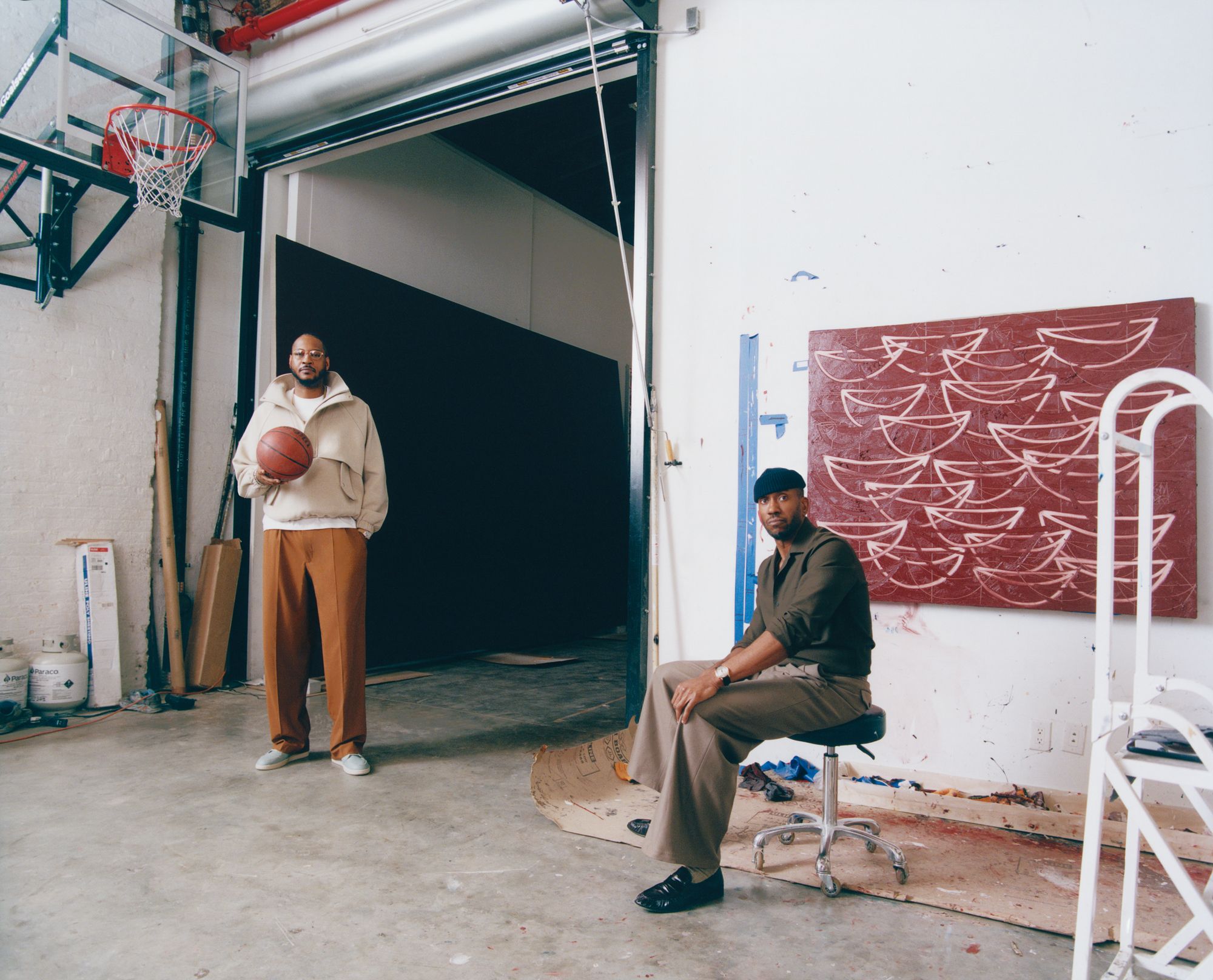
Rashid Johnson is also a sports mega-fan, still loyal to his hometown teams in Chicago, but he’s found some new love for the New York Mets through his collaborative projects with the team owner, mega-collector Steve Cohen. Early in his career, Johnson struck up a friendship with Carmelo Anthony, around the time that Melo started visiting galleries on his days off from playing. The former Knick now occupies a home chock-full of masterworks.
Misty Copeland’s been spending a lot of time at The Met, where she served on the host committee of this year’s Met Gala—but she’s also been spending a lot of time in artist studios and keeps certain friends installed in pride of place in her Upper West Side home. She’s especially fond of Nathaniel Mary Quinn, whose work mirrors the physical poetry she perfected at the American Ballet Theatre, an attentiveness to the human body in all its forms and permutations.
And speaking of The Met, walk into the Roman sculpture wing and you’ll see the marble statue of the Stephanos Athlete, one of the most famous depictions of a person of sports, featured prominently in America’s art museum for more than 60 years, a sculpture that was the height of art-collecting chic among the Roman upper classes. It still holds an immense power, the artwork. When artists choose to depict the world of sports, it’s for one reason: Game recognizes game.
Fashion editors, Khalilah Beavers (Anthony), Karla Welch (Copeland); hair products by Oribe (Anthony, Johnson), Curl Queen (Copeland); grooming products by Orveda (Anthony, Johnson); hair, Jenny Sauce (Anthony, Johnson), Nai’vasha (Copeland); makeup, Victor Henao (Copeland); grooming, Jenny Sauce (Anthony, Johnson). Produced on location by Halle Chapman-Tayler. Artworks: Seascape Snafu: 2026 © Rashid Johnson; courtesy of the artist. Lillies: © Alex Katz/Artists Rights Society (ARS), New York; courtesy of the artist. White Spectral Portal & Black Spectral Portal and Chess Set for Eve Babitz and Marcel Duchamp: courtesy of Rob Pruitt and 303 Gallery. Yolanda Laney, Karis Melo Laney, Betnijah Laney-Hamilton, and Jessie Joy Laney, Brooklyn, New York, from the series The Liberty Portraits: A Monument to the 2024 Champions (2024–2025): © LaToya Ruby Frazier; courtesy of the artist. For details, go to VF.com/credits.
Forget Palm Beach. Wellington Has Plenty of Wealth—and All The Horses
There’s No Stopping Clara Wu-Tsai—or the WNBA
Roger Goodell’s Hollywood Blitz
Where Athletes Biohack Their Way to Glory
Trinidad Chambliss on Why He’s Doing Battle With the NCAA
100 Years of Vanity Fair's Best Athletic Portraiture
The Water Polo Scandal That Rocked LA’s Most Elite Private School
How Maria Sharapova and Serena Williams Went From the Iciest of Rivals to “Sisters”
The Birth of American Sportswear
From the Archive: The Wild, Disturbing Saga of Robert Kraft’s Visit to a Strip Mall Sex Spa