Lisa Kudrow and Michael Patrick King Believe Valerie Cherish's Story Is Universal | Vanity Fair
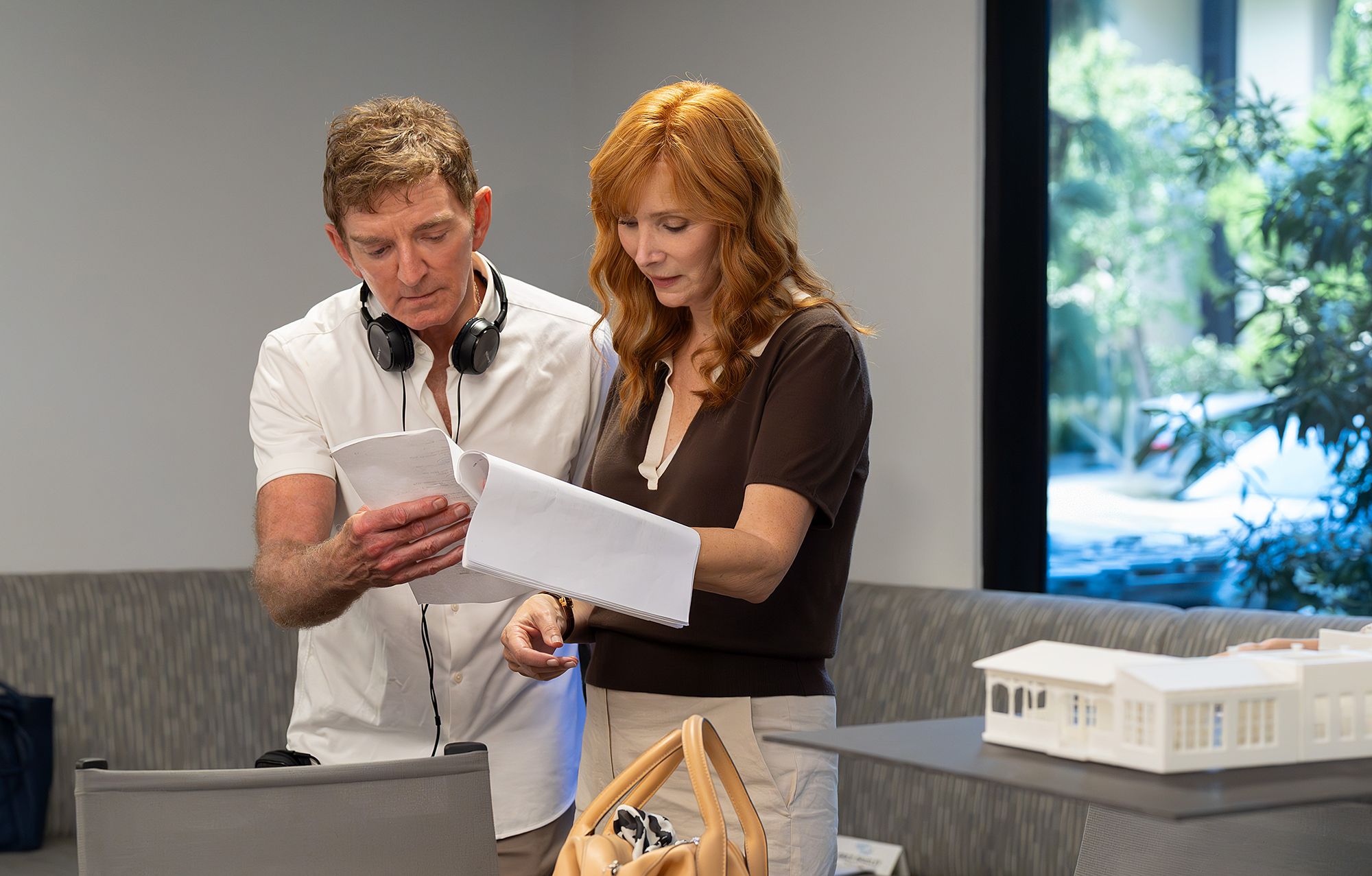
Lisa Kudrow and Michael Patrick King claim no one asked for a third season of The Comeback. “No one told us to meet and come up with an idea,” says King. “It’s just something we have an inexplicable reason and need to do.”
The fans of their comedy series about Valerie Cherish—Kudrow’s aging sitcom actress, who’s white-knuckling her way through Hollywood while simultaneously filming a reality television show about the experience—would beg to differ. The series became a cult hit for HBO after its first season in 2005, then returned for an encore nine years later in 2014.
And really, says Kudrow, the conversation about bringing back The Comeback never stopped. King agrees: Every two or three years, they meet over lunch to throw around ideas. “It’s my belief that Valerie’s always funny,” says King. “There’s always a couple of great ideas, but there’s not the magic key that we need to unlock the reason to do a third season until right before this one happened.” Kudrow puts it another way: “What would make it worth it for us to ask for a third date?’”
It turns out the magic key was one of the thorniest, most hotly debated topics not only in Hollywood, but in the world writ large. “The minute the thought entered that we could jump to the moment where AI is actually a real threat, the dam broke,” says King. The Comeback’s third installment, which premieres on Sunday, March 22 and has already received rave reviews, will find Cherish in uncharted territory, starring in the first sitcom written by AI. The show-within-a-show stars Valerie as Beth, an innkeeper at a bed and breakfast. During that first lunch, while King and Kudrow were improving—as they are wont to do— Kudrow, recalls King, “launched into a monologue about all the things that could go wrong for this innkeeper. She ended with ‘How’s that?’” And just like that, the sitcom’s title—and Valerie’s season three catchphrase—was born.
The precariousness of Hollywood has always been at the heart of The Comeback. After revealing he’s Zooming in from his office on the Warner Bros. lot, King says “question mark?”—alluding to Paramount’s looming purchase of the studio. Back in the early aughts, The Comeback presaged the rise of reality television—expertly satirizing the idea of Keeping Up With the Kardashians and The Real Housewives before they existed. Twenty years later, Kudrow and King have proven prescient once again.
“Everybody seems to be as desperate as Valerie used to be in the first season. And I’m not talking about just people in the business,” says King. “I’m talking about people curating their lives on phones and Instagram. Filters and rejecting takes—doing things more than once because they don’t like how they came across on their Instagram posts. That’s what people thought Valerie was pathetic for, trying to control her image, and now that’s all anybody’s doing.”
“Everyone’s Valerie Cherish now in a way,” he adds. “Everyone’s feeling maybe a little of her need to control the world.” He grins at the camera. “How’s that?”
Vanity Fair: You saw reality television coming with the first season of The Comeback, and you saw the rise of AI coming with the third season. How do you strike gold twice?
Michael Patrick King: The middle one, also! There was a shift in television then, which was to prestige premium cable and dark dramedies. All of a sudden, everybody was doing a dark dramedy. It was premium and prestige.
Lisa Kudrow: The only way Valerie Cherish is part of dark dramedy is if she’s literally written into it. No one is casting her for a dramedy.
King: When Lisa pitched this “actress on a talk show character” that she did that made me laugh so hard at our very first lunch, we knew it wasn’t enough to do a show about an actress. We needed a bigger machine. When we came up with the idea of an actress so desperate she put herself in front of reality cameras, that made it seem prescient at that time. Now it’s an actress dealing with the idea of AI and what that means to the industry. When I pitched it to Casey Bloys at HBO, the first thing he said was, “Yes. Prescient. Fast.” AI is moving fast, so we had to move fast. Our goal was to try to get on the air before some studio actually admits they’re using it. And I think we’ve accomplished that goal.
Kudrow: Well, we’ve got… almost two weeks [laughs].
Can you talk about the formation of Valerie Cherish? Lisa, I know the idea began during your days at The Groundlings.
Kudrow: Yeah. It wasn’t Valerie Cherish at all till Michael and I got together. We created Valerie Cherish. But it was this phony actress on a talk show that I saw at the time. A lot of actors just had this inflated sense of importance to the world. To me, that didn’t feel like a great idea. The funniest line in that [Groundlings] monologue was her plea to the audience: “Let’s save the planet, as a favor to me.” Like, everyone loves actors, so if I ask you, then you’ll just do it.
It started with that. I don’t know, I just thought that’s the right person, right? And Michael agreed that if we’re going to look at reality TV, you don’t want to feel too bad for her. She thinks she can handle anything. And then it turned out to be cringe… for people [laughs].
King: Not for us.
Kudrow: Not for us!
Season three kicks off with Valerie Cherish starring in Chicago on Broadway. Lisa, have you ever been offered an opportunity like that in real life?
Kudrow: No. Of course not. No, no. And that’s right. I should never be approached or thought of to do anything like that.
Really? Why not?
Kudrow: I can’t dance. I can’t sing. I’m not a Broadway-caliber performer. I’m not. I’m not!
King: To see Lisa in a dance rehearsal, it was like catnip. I was like, “I can’t get enough of this.” I was deliriously giggly about seeing Lisa in a Broadway show.
Speaking of Broadway: Gay men really love The Comeback. What do you think it is about Valerie Cherish and this world that is so attractive to gay men, in particular?
Kudrow: I feel like anyone who has felt sort of marginalized, not seen, knows that if you want to be part of the world, you go along to get along, right? You’re just, like, [breaks into Valerie Cherish impersonation] “What’s good about this?” And it’s not idiotic. It’s called surviving. It's only the people that are already part of everything that are like, ‘Oh, this is humiliating,’ But everybody else understands that she’s fine. She’s all right. She knows what she’s doing. I wouldn’t do that. I think I’d protect myself a little more, but she’s [okay].
King: I think there’s a great, great reverence for her resilience in the queer community. “Oh, you’re telling me I’m not it? I’ll show you my version of me not being it.” I mean, we named her first show, I’m It. [Laughs.] And then we made a show about a woman who is being told she’s not it. And one of the things about being queer, growing up queer, is you’re told you’re not it. You know what I mean? And you have to make it your own journey.
In 2017, you lost Robert Michael Morris, who plays Valerie’s beloved hairstylist, Mickey. His spirit is deeply felt on the third season of the show. How did you both navigate that? It must have been really emotional.
Kudrow: It was. I was worried about not having Mickey. How does this work without Mickey? It also kept me away from it for a while. When we would talk about, ‘What could it be?’ I’m like, ‘There’s no Mickey. I don't know.’ Yeah, it was too hard, honestly.
King: He was my college theater teacher. We created this part for a very retired performer to come back and do it. This is the most Mickey thing of all: When he died, I think it was Entertainment Weekly said, “Television star Robert Michael Morris dead.” And I just thought him seeing that in the trades, “Television star”...would almost be worth him leaving. I think he would enjoy that.
What is it about Valerie that keeps us rooting for her, even through all of the flubs and the mistakes?
Kudrow: Well, she’s not a bad person. I mean, she’s ultimately—and not even ultimately—she’s a decent person. She also shows you all the cracks, even if it's not deliberate. You feel like you get her. You see her. And even the pretense is not pretense. She is who she is. Does that make sense? Michael will say something smarter in two seconds.
King: She’s a survivor. And it’s a very rough time. The funny casing of the show is Valerie’s life is rough because she wants to be in show business. But the bigger thought is, everybody’s life can be rough. You just got to keep going. We’ve thought this from the jump: In the very first episode, the only song in the show is Destiny’s Child, “I’m a Survivor.” We’ve been telling people since the very first episode, “She’s a survivor,” and now people know her enough to get a kick out of her. [After] 21 years of knowing her, you can kind of believe she’s a survivor, so you’re rooting for her because she’s…I hate to say it, she’s going for her dream. She’s going for it still.
I know it’s being billed as the third and final season, but it seems like Valerie can exist in every time and place. What would you say once it comes out and people are clamoring for more?
Kudrow: Third and final.
King: It is final. We both are very clear about that. We are the ones who made sure that the word “final” was put on the art poster. Look, Valerie can exist in anything. And, believe me, we’ve figured them all out for 21 years at lunch. Lisa, talk about the fact that you always thought it was a trilogy, abstractly.
Kudrow: Well, I don’t know, I guess I did. But with this idea, it just felt like, “Yeah, it makes it a whole piece.” We started with what felt like an extinction event for writers, for scripted television 20 years ago. And here we are again, and this time it feels like, “Okay, this time it’s real,” but every time it feels real. It just feels like a complete story.
King: Every time it’s felt like the end. When we finished the first one, it felt like the end. And now that same thought is in the air again. But look: Lisa and I both love Valerie so much. And with that respect comes showcasing her in the best possible opportunity to be special. So, to make Valerie ordinary just because you want to see her…get a facial [Kudrow starts laughing], it’s not worth it. Even though it would be a delight to see Valerie get a facial.
Kudrow [as Valerie Cherish]: “That’s too tingly. That’s too tingly, I think. Is it supposed to last that long? It’s, it’s lingering.”
King: And Lisa, wait, now I’m doing the extractions on Valerie’s nose, what does she say?
Kudrow [as Valerie Cherish]: “Too hard, too hard… Too hard. That’s going to scab. I’ve got to shoot something in a week. Oh. All right, well, it’s too late. Right? So, what can you do? Can you… can you... All right, we got to stop. You know what? You’re a doll. You’re doing your job. You’re doing your job, but I can’t, I got to…yeah.”
King: See, it’s Valerie getting a facial! But is it worth a comeback as much as it is just a delight?
Kudrow [laughing]: Season Four: The Facial.
Jeffrey Epstein's Lasting Grip on the Gates Foundation
How Florida’s Space Coast Has Become a Covert Corridor for Chinese and Russian Spies
The Man Who Wants to Save Humanity From AI Is MIA
Crypto’s True Believers Demand to Be Taken Seriously
Glenn Beck’s AI George Washington Is a Right-Wing Sexual Fantasy
“You’ll Answer in Hell”: The Families of Some ICE Agents Are Speaking Out
Kylie Jenner Enters Her Hollywood Era
All the Highlights From the 2026 Oscars and the Vanity Fair Oscar Party
What Really Happened at the Vanity Fair Oscar Party
See All the Photos From Inside the Vanity Fair Oscar Party
From the Archive: The Other Jackie O