Rediscovered 1897 Film Unveils Cinema’s First-Ever Robot
For anyone who has ever dreamed of stumbling upon a cinematic holy grail in a dusty attic, this story delivers.
A Michigan resident has uncovered a viewable copy of a short film by Georges Méliès — the legendary “cinemagician” — inside an old, worn trunk of nitrate film rolls that once belonged to his great-grandfather.
Before this find, no screenable versions of the film were believed to exist anywhere.
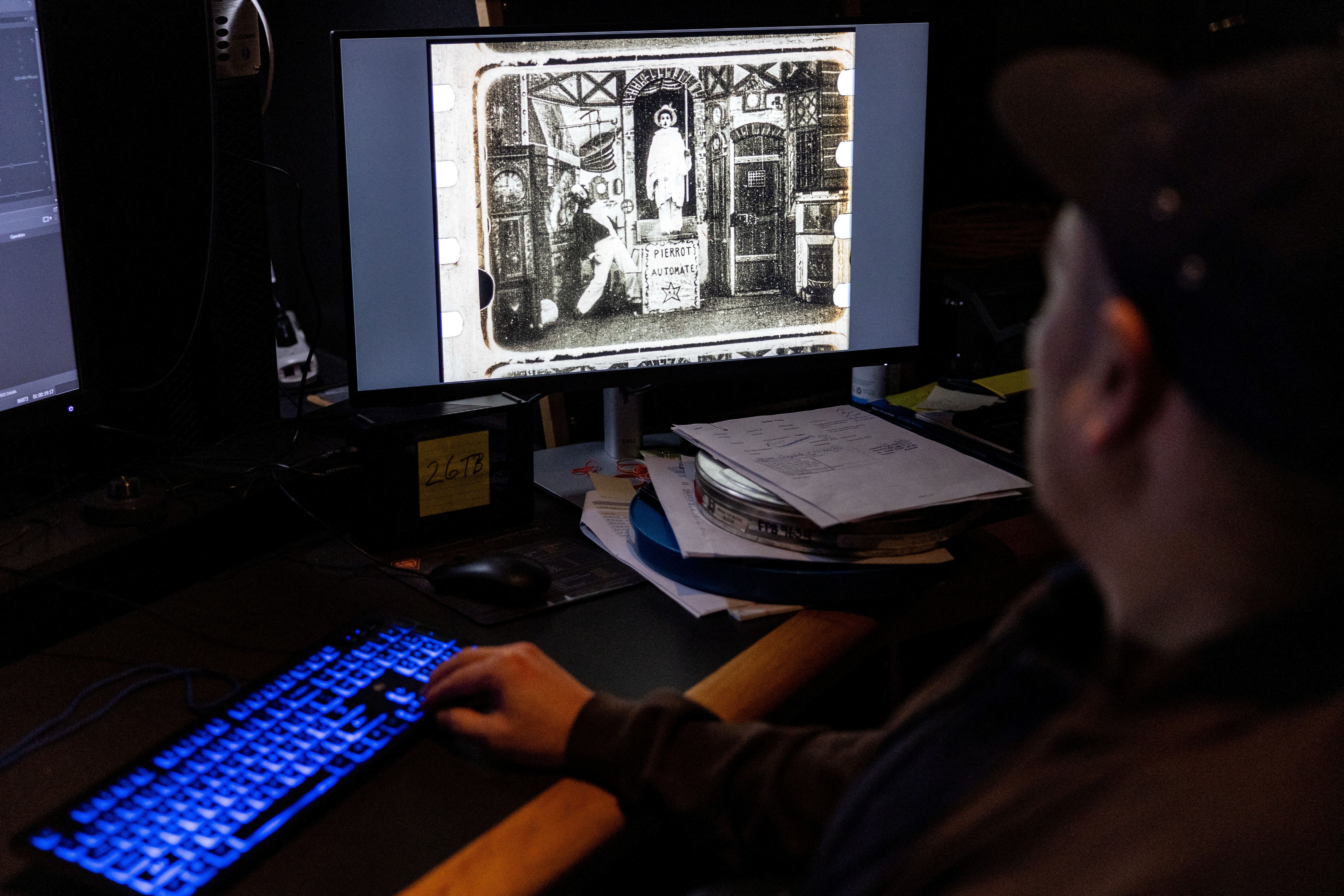
The film is Gugusse and the Automaton, a roughly 45-second comedic production dating back to approximately 1897.
Its significance extends well beyond its rarity: the short is recognized for featuring cinema’s earliest depiction of a robotic character, a mechanical human-like figure called Pierrot Automate positioned atop a pedestal adorned with a dark-colored star.
That robotic debut predates the actual coinage of the word “robot” by more than 20 years, according to the MIT Press Room.
The reels originally belonged to William Delisle Frisbee, a Pennsylvania resident who worked as a potato grower, classroom instructor and mobile film exhibitor.
Frisbee journeyed around Pennsylvania using a horse-drawn carriage, his traveling kit stocked with films, lantern slides, projection equipment and a phonograph. He held showings in community venues like churches, school buildings and public halls, and kept detailed journals describing full venues and lively crowd reactions.
He passed away in 1937, and his two modest trunks containing projectors, reels, journals and documents were handed down across family generations.
Bill McFarland, a retired educator from Grand Rapids and Frisbee’s great-grandson, delivered the trove to the Library of Congress’ National Audio-Visual Conservation Center in September.
McFarland acknowledged he had no understanding of what the films contained or any means to play them back. He simply felt the collection was too valuable to discard.
“It was just this trunk of films that seemed too good to throw away,” McFarland told Agence France-Presse (AFP). “But I had no idea what they were or how to show them.”
The trunk contained approximately 10 reels of deteriorated film. Many were in poor condition: rusted, warped, fragmented or fused together.
Archive technician Courtney Holschuh and vault supervisor George Willeman carried out the examination inside the center’s dedicated nitrate film storage area.
Willeman identified the on-screen magician as Méliès himself, who frequently appeared as the lead in his own productions. To confirm the identification, Willeman contacted an acquaintance with specialized knowledge of Méliès’ work.
That expert responded within 24 hours, confirming the reel was the missing Méliès title.
For those who know Méliès primarily through his most famous surviving work, this discovery adds another tangible piece to a filmography that was largely destroyed.
Born in Paris in 1861, Méliès started as a stage magician before viewing screenings by Auguste and Louis Lumière in 1895. The siblings were responsible for creating the Cinématographe, a combined camera and projection device.
That exposure inspired Méliès to begin his own cinematic experimentation, and his innovative visual techniques earned him the nickname “cinemagician.” He went on to produce over 500 films throughout his career.
Here is a detail that should resonate with anyone who follows debates about content duplication in the digital age: because of their popularity, Méliès’ productions were frequently duplicated without authorization.
The newly surfaced copy of Gugusse and the Automaton is not a first-generation print but rather a reproduction several generations removed from the source.
In a bitter irony, unauthorized copies may be the only reason some of his work survives at all. During World War I, silver and celluloid from many original Méliès negatives were extracted by melting them down.
Archivists devoted over a week to scanning and converting Frisbee’s copy of the film into digital format.
The restored film can now be streamed online at 4K resolution — meaning a production made in the earliest days of cinema is now available at a clarity its creator could never have imagined.
“This is one of the collections that makes you realize why you do this,” said Courtney Holschuh, per the Library of Congress.
The Frisbee collection did not stop at a single treasure. It additionally included another Méliès piece, The Fat and Lean Wrestling Match from 1900, as well as partial footage from Thomas Edison’s 1896 production The Burning Stable.
For a traveling exhibitor hauling reels by horse-drawn carriage through rural Pennsylvania, these films were entertainment. More than a century later, they are irreplaceable artifacts — rescued from rust and decay by a great-grandson who simply could not bring himself to throw them away.