Impact of New York Doormen Strike on Manhattan's Luxury Apartment Buildings | Vanity Fair
On Wednesday, thousands of doormen, porters, and supers working in New York City apartment buildings voted on a question: Should they strike? The answer was a definitive one: Yes. Yes, they should.
After more than a month of negotiation, their union, 32BJ SEIU, has so far failed to reach a new contract with the Realty Advisory Board on Labor Relations (RAB), which represents the owners and operators of New York real estate. The current contract expires on Monday, April 20, at midnight. Among other things, 32BJ wants wage increases and pension improvements, as well as to nix a proposal that would shift some health care costs onto building workers.
RAB says that it can’t afford to raise wages, especially in anticipation of Mayor Zohran Mamdani’s promise to freeze rent on rent-stabilized apartments: “The New York City residential real estate industry is facing mounting pressures, including the likelihood of 0% rent increases on stabilized units for years to come, overregulation, and rising operating costs,” says RAB president Howard Rothschild in a statement. “Now is the time for both sides to come together and negotiate a contract that reflects these realities and supports a viable path forward.”
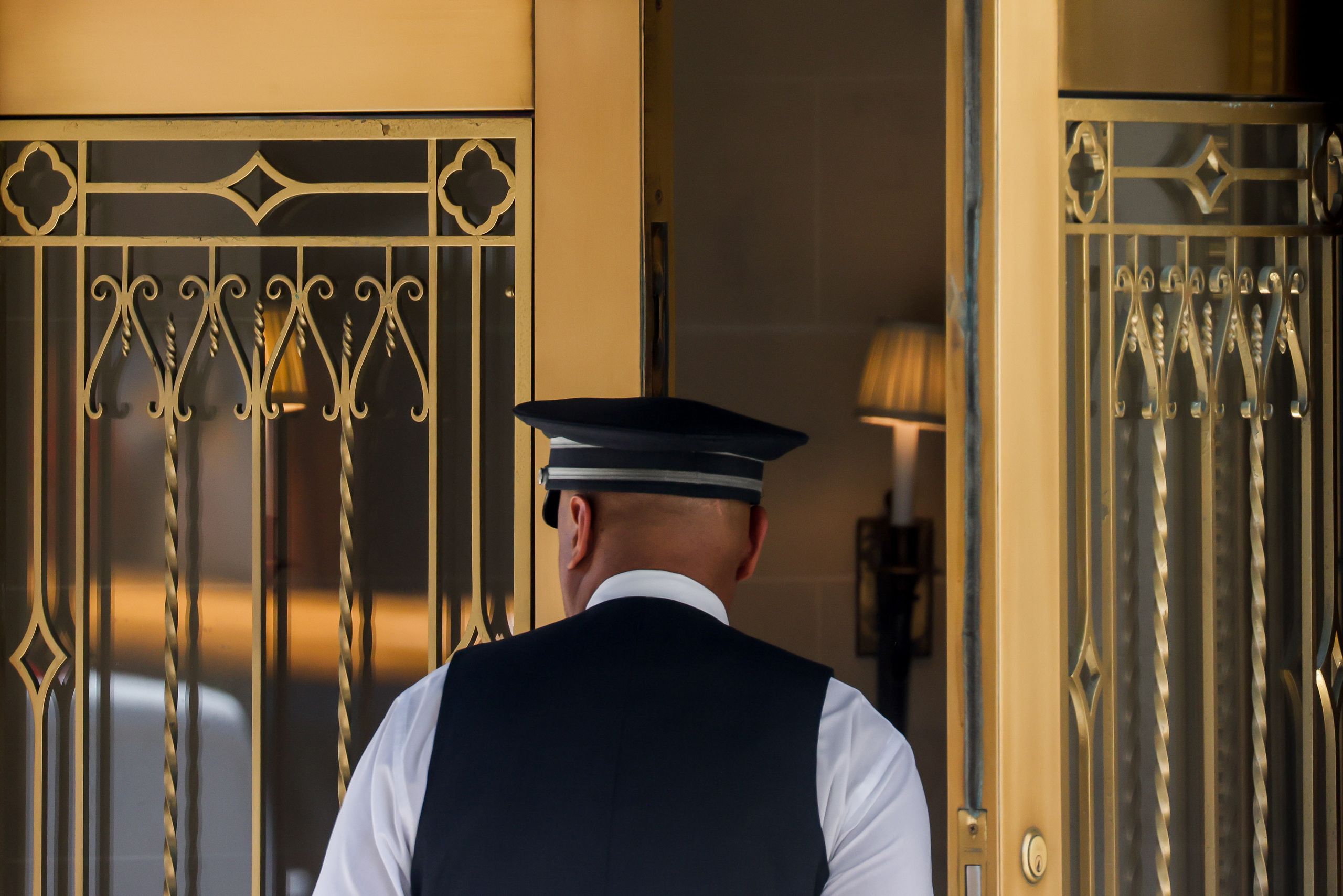
A doorman stands outside a building on Central Park West in 2006.
“The RAB’s proposals to cut costs on the backs of its essential workers are insulting,” counters 32BJ president Manny Pastreich. “Claiming landlords can’t raise rents flies in the face of the real-life experience of most New Yorkers, including our members, [who are] fighting to make ends meet. While the residential real estate industry continues to thrive with record-high rents, high property values, and historic low vacancy rates, many of our members are struggling just to keep up.”
On Wednesday, more than 10,000 union members held a rally on Park Avenue in the east 70s and 80s, a modern-day millionaires' row that’s famous for its luxury, full-service doorman buildings. If an agreement isn’t reached by midnight on Monday, union members will walk off the job.
For New York, a city of hustlers and strivers, living in a doorman building has long been a signifier that you’ve made it—that you’ve reached a socioeconomic status that finally allows for urban life to be a little bit easier. That’s thanks to the doormen, porters, and supers: They sign for your packages. They collect and dispose of your trash. They keep spare keys so you’ll never lock yourself out. They hail cabs, even in a blizzard. They’ll fix your leaky sink. They’ll oversee furniture delivery or appliance installation. They let guests up to your apartment and keep unwanted visitors out. In some buildings, they’ll receive your groceries or dry cleaning and put them in your apartment for you. In every building, they’ll greet you each morning and night when you walk in the door, maybe with a treat for your dog or a lollipop for your child.
And now they all might be gone. For how long, we don’t know. The last doorman strike in New York was in the spring of 1991. It lasted 12 days. How did the city handle it? Honestly, not well.
Thousands of 32BJ SEIU building service workers at a rally on April 15. They voted to authorize a strike that will impact more than 3,300 residential buildings in New York City.
“The plumber can’t come, so the pipe keeps leaking,” Dennis Hevesi wrote for The New York Times on May 2, 1991. “The baby’s diapers are doing the same, but the diaper man can’t deliver. The movers can’t move, so some people are stuck paying two rents—for the apartment where they must still live, and for the one where they should now be living. And tenants all around town are fuming when they’d rather be fumigating as the garbage piles up and the pests burrow in, but the exterminator can’t get into the building. Help!”
“Doorman walk line, not lobby” read a headline in the Daily News. Other colorful headlines from that time? “It’s an open-your-own-door-policy” and—on A1 of The New York Times: “New Yorkers Hail and Haul as Building Workers Strike.”
“It’s an open-your-own-door-policy.'
These all might seem like minor annoyances that impact a minor group of New Yorkers—around 1.5 million people live in doorman buildings out of a citywide population of nearly 8.5 million. But just like the subway, the city is more interconnected than we think. Within days, then mayor David Dinkins had to declare a health emergency due to all the uncollected trash. The sanitation department refused to cross the picket line to pick up garbage from doorman buildings.
“[The] mountain of garbage has been festering in front of the struck buildings, mostly on Manhattan’s Upper East Side, often poorly packed into plain brown bags,” wrote The Daily News, “and at this point being raided by the homeless and spilling into gutters.”
A doorman hailing a cab on 2nd Avenue on the Upper East Side amid a snowstorm.
A number of high-profile New York politicians are backing 32BJ. Jack Schlossberg, congressional candidate for New York’s District 12, posted his support for the union on X: “Doormen and other essential residential workers keep NYC RUNNING !!” he wrote above a video of the rally on Park Avenue. In a statement to Vanity Fair, Alex Bores, another candidate for New York’s District 12, also backed 32BJ: “For many New Yorkers, 32BJ members are the first and last people they see outside their family each day. They help make our apartments feel like homes. They’re fighting for fair wages and benefits—in particular, health care coverage—that is not only what they deserve but benefits everyone they come in contact with each day. I’m proud to stand with them.”
Like Gotham Cinderellas, New Yorkers are already starting to prepare for what might happen when midnight strikes on April 20. Some buildings are hiring security guards. Others are requiring residents to sign up for temporary ID cards. Flyers are hung outlining new, strike-era rules: No renovations or construction, no move-ins or -outs. Then there are the frantic calls for volunteers to monitor the lobby. But mostly? Residents are in the dark about maybe being quite literally in the dark. My super did always help me change those ceiling lightbulbs.