The Nationalist Ideologies Behind the Tragic Deaths of Alex Pretti and Renee Good | Vanity Fair
In the wake of poet and writer Renee Good’s killing, Donald Trump and his collaborators have done all they can to define her as an enemy of “The Homeland.” The administration claims, for instance, that Good was a “domestic terrorist,” a term it is now applying to Alex Pretti, the ICU nurse whom federal agents killed on Saturday. This rhetoric is employed to justify the state taking life, by associating the dead with national villainy. But the campaign against Good is different—because The Homeland takes particular and perverse interest in women deemed insufficiently reverent of hearth and home. Trump propagandists tell us that Good was part of a growing cabal of insolent white ladies turned violent; that she was a “lesbian agitator” in league with “68 IQ Somali scammers”; or that she was simply, as her killer apparently labeled her, “a fucking bitch.” For these and other sins, her castigation has extended into the afterlife: with Elon Musk’s AI tool, Grok, users churned out deepfakes of Good with bullets in her head and of her corpse in a bikini. This is all appropriate: In defending the undocumented, Good violated the sanctity of The Homeland, which is to say that she questioned the divine promise of American soil to a mythical and singular people.
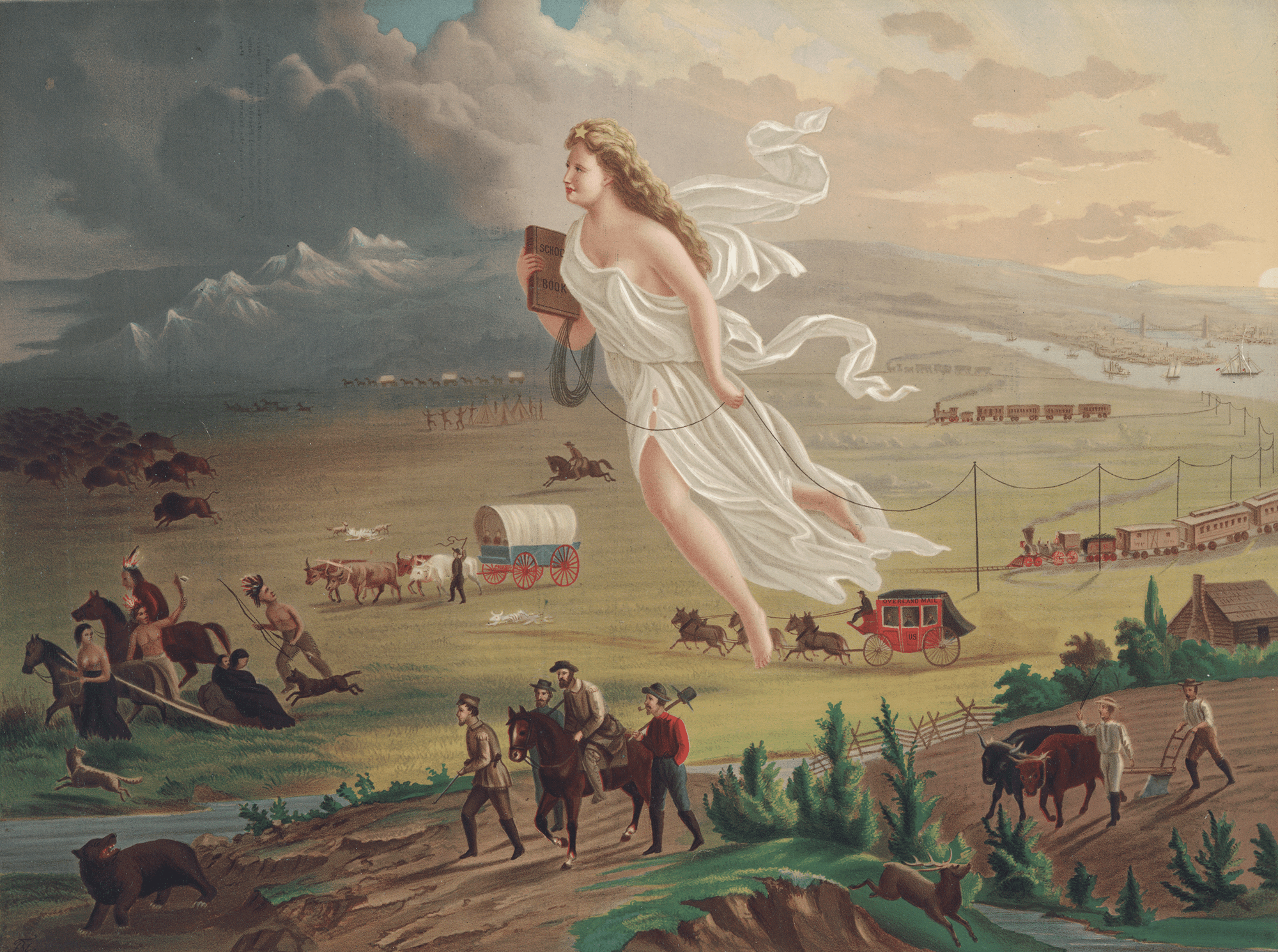
For The Homeland is not “The State” or even “The Country.” The Homeland is not defined by simple geography. It exists beyond laws and norms. It is unconcerned with traditional American concepts like “liberty,” “freedom” or “pluralism.” The Homeland is that piece of earth providentially deeded to The Volk. The Homeland’s borders are drawn in untainted blood, its sanctity exemplified in proper gender conduct and the fulfillment of gender roles. It is The Homeland that ICE venerates in its recruitment posts festooned with victorious white settlers and vanquished indigenous Americans. It is The Homeland that Musk saluted (twice) at Trump’s inauguration. It is The Homeland that the late Charlie Kirk was fond of invoking:
I want to be able to get married, buy a home, have kids, allow them to ride their bike till the sun goes down, send them to a good school, have a low-crime neighborhood, not to have my kid be taught the lesbian, gay, transgender garbage in their school. While also not having them have to hear the Muslim call to prayer five times a day.
It is often said that The Homeland is skeptical of immigrants, but more precisely, The Homeland is skeptical of aliens. Asylum-seekers from Gaza fleeing a genocide have no place in The Homeland; Afrikaners suffering the indignity of post-apartheid are welcome. The Homeland is covetous of Northern Europeans, but regards Somali Americans as “garbage.” “Why can’t we have some people from Norway, Sweden, just a few?” Trump recently said. “But we always take people from Somalia, places that are a disaster, right? Filthy, dirty, disgusting, ridden with crime.” The criteria for these distinctions—between putative immigrant and indelible alien—are not complicated; for above all, The Homeland is a racist project.
Securing The Homeland, they tell us, is an existential priority. It is also content.
Securing The Homeland is the central feature of the Trump administration. In Los Angeles and Chicago, Trump seeks to cleanse it. With Greenland and Venezuela, Trump seeks to expand and enrich it. Heterosexual men are the rightful defenders of The Homeland. Lesbian agitators, such as Good, are its nemeses. Christians are the lifeblood of The Homeland. “Stupid Muslims” are its cancer. A characteristic of The Homeland is that its foes must be subhuman—members of the LGBTQ+ community are “freaks,” disagreeable women are “ugly” pigs, and the residents of DC are “cockroaches.”
For years a certain kind of liberal has either minimized such culture-war rhetoric coming from the other side or urged political actors of all stripes to ignore it in favor of “material” or “kitchen table” issues—as though the state regarding one’s life as “garbage” has no tangible consequence, as if the terms of a fight can be determined by the person getting punched. But Trump has clarified an inconvenient fact—the culture war is an actual war. ICE, full of myrmidons of The Homeland, enjoys an $85 billion budget, a sum “larger than the annual military budget of every country in the world except the United States and China,” as Caitlin Dickerson reported in The Atlantic. “Immigration and Customs Enforcement—just one component of the Department of Homeland Security—is getting more money than any other law enforcement agency in America.
Befitting an administration filled with reality TV stars, a policy of human pain and suffering is presently being repackaged as spectacle.
Deportations are up under Trump, but that is not the true purpose of ICE. “They’re not serious about getting rid of as many people as they can. They’re serious about causing human pain and suffering,” a former ICE official told Dickerson. “Putting someone into detention isn’t a removal, it’s a punishment.” Thirty-two people died in ICE’s custody in 2025—the highest number in 20 years. And befitting an administration filled with reality TV stars, a policy of human pain and suffering is presently being repackaged as spectacle. Activists arrested in defiance of The Homeland have had their portraits altered via AI. Minor celebrities, their dubious status on the wane, have sought to supercharge their prospects by accompanying ICE on raids or even joining its ranks. Kristi Noem, the head of the Department of Homeland Security, posed in front of a group of immigrants sent to a torture site in El Salvador, in a show of sadistic titillation. Last June, LA County supervisor Janice Hahn watched as Noem led an ICE raid in Huntington Park. “I could tell she was doing a full camera crew production,” Hahn said. “She was getting hair and makeup done.” Noem, like the president she serves, has a flair for the theatrical. She cosplays in camouflage and bulletproof vests. The focus on appearance and production value is essential in a movement that seeks not just to purify the actual America, but to resurrect the America of legend and myth. Securing The Homeland, they tell us, is an existential priority. It is also content.
Many Americans horrified by The Homeland’s agents rampaging through whole communities, seizing children, perp-walking half-naked old men, and detaining whomever they feel like, with or without charges, all while enjoying “absolute immunity,” have settled on an interesting term: 'occupation.” This designation is as correct as it is unoriginal—a fact more Americans would do well to remember. ICE has contracted surveillance tools that, according to Joseph Cox at 404 Media, allow it to “track phones without a warrant and follow their owners home or to their employer.” These tools, reportedly deployed across Minneapolis, were not created in America, but in Israel, still another homeland, enforcing the longest “occupation” in modern history. Thus, the citizens of Minnesota have, as American taxpayers, subsidized an occupation overseas that is effectively a laboratory for their own.
We did not blindly stumble into this era of Homeland rule. Almost 25 years ago, when the Department of Homeland Security was first proposed, there were inklings, even among supporters, that things might someday come to this. “Homeland isn’t really an American word,” Peggy Noonan wrote in The Wall Street Journal in 2002. She supported the formation of the department. But something bothered her about the name. “It’s not something we used to say or say now. It has a vaguely Teutonic ring—Ve must help ze Fuehrer protect ze Homeland!” Blogger Mickey Kaus, writing for Slate that year, echoed Noonan’s concerns, noting that the proposed department name “explicitly ties our sentiments to the land, not to our ideas.”
Russell Feingold, who was the junior Wisconsin senator at the time, saw something more substantive at work. Feingold saw gaps in the legislation that a would-be tyrant could easily exploit. A figure like that would be completely lacking in virtue, and Feingold’s colleagues could not imagine that the American people, in their infinite wisdom, would allow such an archvillain to ascend to the presidency.
“People said, ‘Russ, no president would do X, Y, or Z,’” Feingold recently told me. “In other words, the norms are strong enough that you’re just sort of a Cassandra.” Feingold was the lone Senate vote against the Patriot Act, and one of only nine senators to oppose the creation of the Department of Homeland Security. Feingold watched with alarm as, in the wake of 9/11, the country’s immigration policy was subsumed by counterterrorism.
“As soon as 9/11 occurred, within seconds, it became clear that the Bush administration was going to target Muslim and Arab Americans,” Feingold said. Indeed, over a period of months, the FBI detained 762 undocumented immigrants, mostly from Muslim or Arab countries, as persons “of interest.” The Department of Justice’s Office of the Inspector General later reported that detainment could result from something as simple as “a landlord reporting suspicious activity by an Arab tenant” or possession of “suspicious items,” such as pictures of the World Trade Center and other famous buildings. These men were held for weeks or months, with some denied contact with legal representatives, some physically abused, and some put on 23-hour lockdown. Most were deported. And despite being investigated in the wake of 9/11, none were ever charged with anything related to terrorism.
Feingold saw gaps in the legislation that a would-be tyrant could easily exploit. A figure like that would be completely lacking in virtue, and Feingold’s colleagues could not imagine that the American people, in their infinite wisdom, would allow such an archvillain to ascend to the presidency.
In 2008, after Barack Obama won the Democratic primary, Feingold began to see another, older trend emerge, one that is foundational to the Homeland mythos. While in the Senate, Feingold made a point to hold town meetings in all 72 of Wisconsin’s counties. The meetings were, by his telling, “pretty mellow,” filled with supporters and few conservatives. “They were always civil,” Feingold said. “And then Obama is elected, and…I start going to these last 15 or so town meetings, and it was unbelievable. The guy wasn’t even sworn in yet. And all of a sudden, all these people started coming, a kind of tough-looking crowd, and booing and saying, ‘He’s a socialist; he wasn’t born in the United States; he’s going to do this, he’s going to do that,’ and there was fire in their eyes. And it was very strange, because Obama had won many of these counties in the rural areas, and yet there was this thing that was happening.
When pundits later tried to chalk up the growth of the Tea Party, then Trump’s first election, to “economic anxiety” and a snubbed working class, Feingold was skeptical. There was “this whole dynamic that coalesced [into] this sort of feeling of white people being under siege,” Feingold said. “That, to me, is sort of the political context that opens the door.
But skeptical as he was, Feingold never saw things advancing this far. (He lost his 2010 reelection bid to Republican Ron Johnson, a Trump ally who remains in office and has yet to comment on the killing of Pretti.) “I’ll be the first to admit, the reason I did it was because I feared that someday there could be somebody who would do some of these things in an abusive way,” Feingold said of his vote against the DHS, “but I never imagined that there would be somebody who would do all of these things at every opportunity.
The problem will almost certainly outlive Trump’s presidency. ICE’s budget has steadily increased through Democratic and Republican administrations. That funding has gone to what journalist Radley Balko calls “the most rogue, renegade, and certainly pro-Trump police agenc[y] in the federal government.” No matter who wins the midterms this year, or the presidential election in 2028, the Army of The Homeland will remain, and its enemies in the Democratic Party seem to have little desire to fight back.
And so then it falls to the people themselves.
In these moments, I find comfort and inspiration in ancestors and martyrs. More than half a century ago, as the writer Jelani Cobb recently noted, activist Viola Liuzzo, a housewife and mother of five, left her family in Detroit and headed south to join the march to Montgomery, and in the process left the privileges of white ladyhood behind. For transgressing against The Homeland of that era—the neo-Confederate South—Liuzzo was murdered by white supremacists. Just as Good was slandered by The Homeland’s authorities as a domestic terrorist and a “fucking bitch,” Liuzzo was slandered by The Homeland’s rulers as a heroin addict and nymphomaniac who’d gone south to make a cuckold of her husband.
But the slander was, itself, revelatory, for it demonstrated The Homeland’s perverse, exacting norms, its obsession with hierarchy, its rigid borders and the high price levied on anyone who dared cross them. Forces of the neo-Confederate South “did not simply represent a threat to African Americans, as was the popular perception,” Cobb wrote. “They were a mortal danger to anyone who disagreed with them, regardless of the person’s race, background, or gender.”
Perhaps we are in such a moment now, where a death demonstrates to the country the broad nature of the threat. But this is a passive hope, and in Liuzzo’s life, we find a more active call to action. Liuzzo was born into poverty. Her father was a coal miner; her husband, a union organizer. Hers was the kind of salt-of-the-earth family often celebrated in the anthems of The Homeland. Whereas The Homeland sees freedom as the sole prerogative of its tribe, Liuzzo’s vision extended out to humanity itself. While understanding the economic exploitation of her family, she also understood that whiteness had enrolled her in the exploitation of others.
When Liuzzo acquired this knowledge, when she got woke, she was transfigured into a traitor to her race and a menace to The Homeland. For being a menace, for being woke, she was killed—as was Renee Good. (As was Alex Pretti.) But revelations have their blessings too. In this case, a life, however brief, that is clean and does not depend on the oppression and debasement of others. The revelation of deep human ties, the belief that we are all equally chosen, doomed Liuzzo, Good, and Pretti, as revelation so often does. But it also immortalized them.
Exclusive: Ye, Formerly Kanye West, Tells VF About His WSJ Apology Advertisement
How the Louvre’s Stolen Jewels Turned Up at Paris Haute Couture Week
The Meteoric Rise of Connor Storrie and Hudson Williams
Meet Alexis Wilkins, the Zoomer First Lady of the FBI
The 11 Biggest Oscar Nomination Snubs and Surprises
The Life—and Shocking Murder—of Playboy Playmate Dorothy Stratten
Belle Burden On Her Family’s “Legacy of Infidelity”
Susie Wiles, JD Vance, and the “Junkyard Dogs”: The White House Chief of Staff On Trump’s Second Term
From the Archive: The Alexander Brothers Built an Empire. Their Accusers Say the Foundation Was Sexual Violence.