Hollywood Embraces the Allure of LACMA’s World | Vanity Fair
On Thursday night, Peter Zumthor was standing underneath the museum he’d spent decades designing. He was by himself, surrounded by hundreds of Los Angeles cultural Brahmins, all in black tie for LACMA’s opening gala for the David Geffen Galleries. In the years after the museum broke ground, Zumthor, the Pritzker Prize winner who designed it as his first building in the United States, stayed mostly in Switzerland. He arrived a few days ago. At a press conference in advance of the event, he drank an Erewhon green juice. On Friday, he was set to sit for an interview with filmmaker Wim Wenders, who has spent 12 years making a documentary on Zumthor. Wenders told me he was waiting for the museum to open to finish his film. He wanted to finally capture Zumthor in the building.
I asked Zumthor what it was like to be here.
“It’s nice,” he said. He seemed intensely happy but a bit dazed, almost like he was in a dream. “Do you like it?”
He turned around to face the swooping concrete undercarriage of his structure and started drawing the lines with his finger. He stopped his hand when he got to the speakers, which were blasting music.
“What…is that?” Zumthor asked.
He loved it. I turned him around, and in front of him, live, not on the speakers, was a procession of masquerade performers from Lagos.
Architect Peter Zumthor and LACMA CEO Michael Govan
On Thursday, LACMA hosted 800 donors, board members, artists, LA gallerists, celebrities, and musicians at its new building, the David Geffen Galleries, which will open to the public next week. For the April issue of Vanity Fair, I spoke with LACMA director Michael Govan about the process of opening the building, the culmination of his lifelong quest to dream up new spaces for art—and at the press preview on Wednesday, he seemed even more buoyant than usual, happily greeting me as I rolled up, suitcase in hand, from the airport. Everyone seemed ecstatic. The opening bash for a new museum is a rare bird: donors can see where their massive checks went, while the public will soon see their tax dollars going to a new cultural citadel. Yes, it was a fundraiser, a massive one—the night pulled in nearly $11.5 million for the museum. But museums have galas every year. Museums only open once.
In reaching for a comparison, I thought back to the hoopla tied to the completion of Crystal Bridges, the nonprofit art museum in Bentonville, Arkansas, founded by Alice Walton, or the debut of Glenstone, the astounding museum started by collectors Mitchell Rales and Emily Wei Rales in Potomac, Maryland. Neither was close to this. A better comparison would be the opening of the Whitney Museum of American Art’s new building, designed by Renzo Piano, in the Meatpacking District—I was there for that bash; Rufus Wainwright sang Billy Joel’s “New York State of Mind” in front of the Hudson River, and the crowd went nuts.
But LACMA’s new building, with its massive institutional footprint and giant budget to match—the museum placed the final cost at $720 million—puts it in another stratosphere.
“Really, this might be the most important museum in the country built in, oh, I don’t know, decades?” Bob Iger, the former CEO of The Walt Disney Company, told me. He was there with his wife, Willow Bay, who has been a board member for years and chaired the big party Thursday night. She also, with Iger, has funded the replacement of bulbs in Chris Burden’s Urban Light, the marvelous arrangement of old streetlamps in front of the museum that’s become the most photographed object in Los Angeles.
“I’m just the husband here,” Iger said.
Willow Bay and Bob Iger
He added that it was heartening to see that the artists present at the gala loved the new building. The David Geffen Galleries doesn’t primarily exist to show work by living artists; the contemporary shows and collection will still mainly be housed in the Broad Contemporary Art Museum and the Resnick Exhibition Pavilion. But the artists in attendance last night did love the new building, in the way that artists in New York love going to The Met. I spoke with Lauren Halsey (who does have work in the new building, actually), Jonas Wood, Mark Grotjahn, Julie Mehretu, and Jordan Wolfson. Discerning voices, all of them, not ones to bite their tongue—but all seemed totally won over by the daring nature of the single-floor schematic, the old-new audacity of the patina-worn concrete walls. Alex Israel walked up the stairs at the start of the evening, taking it in with the collector Joel Lubin, marveling at the wonder of it, looking at the ocean of bow-tie-wearing men and sequin-clad women entering the sculpture garden below. Catherine Opie snapped selfies with patrons, and Ed Ruscha walked through the atrium, where Tino Sehgal debuted a new performance, to find three of his photographs from the ’60s installed just off the room with Renaissance paintings. Francesco Vezzoli said it was “the dream of America” to have a building like this for art in Los Angeles.
Fellow museum directors shared the sentiment. Klaus Biesenbach, who runs the Neue Nationalgalerie in Berlin, said it was “huge, and big, and hugely big.” Max Hollein, the director of The Met, looked up and approved of the West Coast’s new encyclopedic museum. Scott Rothkopf, the director of the Whitney, was on hand to fête the new space, as were Glenn Lowry, the former director of MoMA, and Sheikha Al Mayassa bint Hamad Al-Thani, the chairperson of Qatar Museums. George Lucas and Mellody Hobson, who are readying their own massive museum project a few miles away, were there as well.
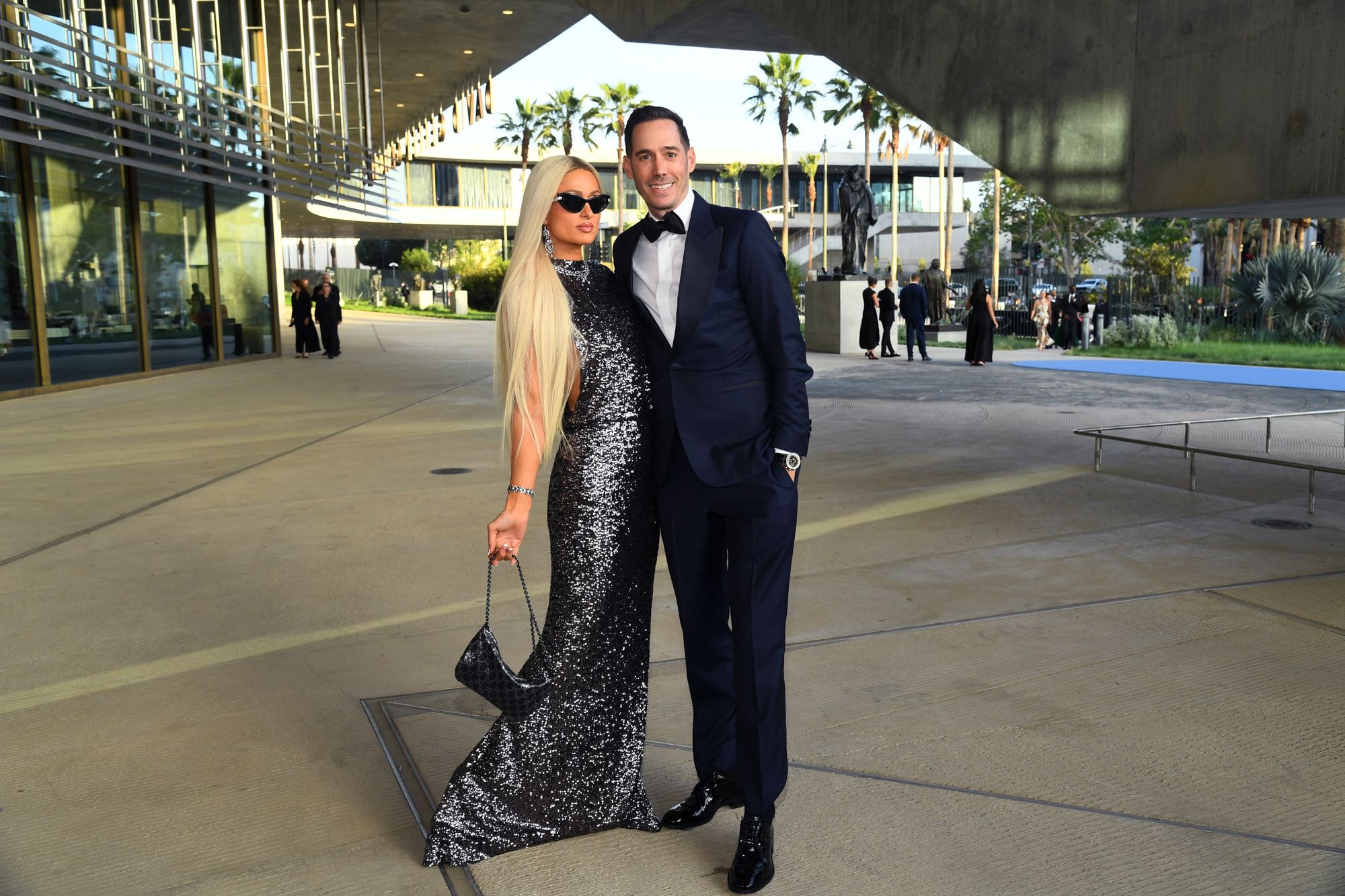
But there’s a certain significance to this museum coming to life in the city that birthed the dream machine that is Hollywood—Bay, in her remarks, called Los Angeles “the storytelling capital of the world.” The Tinseltown royalty in attendance were there to merge the two branches of the city’s culture: pop culture and powerful art, as displayed on the walls and in a sculpture garden. It gave me great pleasure to see Paris Hilton—who has headed up digital initiatives for the museum—deep in conversation with Jeff Koons, or Sharon Stone chatting with the collector Maja Hoffmann, or Tom Hanks catching up with Chris Paul, the former Clippers star. And at one point I was politely but firmly nudged by someone at the bar, and I realized they were getting through to say hello to Ted Sarandos. Why not link and build with the man who controls Netflix at the opening of LACMA? It’s all culture!
Tom Hanks, Rita Wilson, and Catherine Opie
As attendees made their way to dinner, I spotted G-Dragon, the king of K-pop, standing by the concrete wall of the museum, next to Will Ferrell and his wife, LACMA trustee Viveca Paulin-Ferrell. G-Dragon had just performed with BigBang at Coachella. “Coachella was great. I was there with my boys,” he said. He hadn’t been into the museum yet, “but it looks pretty sick.”
Kim Petras was catching up with Alexander Wang, who just opened a museum of his own, on Canal Street in New York. Former Google CEO Eric Schmidt was walking by Sotheby’s CEO Charles Stewart; Lauren Halsey was chatting with the collectors Alicia Keys and Kasseem “Swizz Beatz” Dean; Larry Gagosian said hello to Angeleno collector Maria Bell; and Alejandro G. Iñárritu was chatting loudly in Spanish among friends. At the table—I was seated with Matthew Marks, Jack Bankowsky, the artist Pedro Reyes, and Wenders, who was in an unbelievable Yohji Yamamoto ’fit—all the food was from Gabriela Cámara, the chef at Mexico City’s Contramar, Govan’s favorite restaurant in the world, and maybe mine too, actually. It’s where all the artists and collectors and dealers in Condesa sit down for a long, leisurely Friday lunch at 1 p.m., one that ends around 7 p.m. A magical place.
Bay and fellow host Tony Ressler took the stage for a long evening of toasts and speeches, honoring Govan and Zumthor, but also David Geffen, who kicked the entire project into gear with his $150 million donation in 2017. Bay called him “the boy from Brooklyn who made LA his home,” noting that this museum would soon be a cultural home to so many transplants in this city.
Lynda Resnick took the stage to introduce Govan, recalling years of memories with him and his wife, Katherine Ross: meeting them when they first arrived in LA; fêting him at Bobby Kotick’s house; peeling grapes with him; convincing him to take the LACMA job.
G-Dragon
“He built it,” Resnick said. “They called him reckless. Headlines screamed suicide by architecture. But only one person could have done this. Generations will cross that bridge.”
And then Govan took the stage to a standing ovation, decades after he first had the dream of building this thing, with no other museum project remotely as ambitious foreseeable in the near future.
“We think of this building not as an end of anything, but as a beginning, a platform for experimentation, for new idealism,” he said. “History is always changing. We’re always looking at it in a different way, and we hopefully have built an instrument to capture our continued thoughts. I want to thank all of you for making this possible.”
And then he revealed that he had asked his friend T Bone Burnett to finagle a Bob Dylan performance to open the museum. He wanted to hear “The Times They Are A-Changin’.” Dylan was tied up, so Burnett decided to sing the song himself. Like Wainwright going into Billy Joel mode at the Whitney, this is what I’ll remember from the night—a legend of American music singing a song that I’ve heard a thousand times, a song that somehow can’t sound old.
And then everyone walked outside to see Chris Burden’s Urban Light, its bulbs blazing.
Meet the Man Who Will Get Inside Trump’s Mind
What Happens If New York’s Doormen Go on Strike?
Is Coachella Still Cool?
What the Fashion at Coachella Says About the State of the Festival
Shawn Hatosy Is the Internet’s Newest Babygirl
Everything You Need to Know About South Korean Chaebols
A Brief History of RFK Jr.’s Fascination With the Animal Kingdom
A Reality Check on Reality TV
I Cried Over One of Gwyneth Paltrow’s Fast-Casual Salads
How Elle Fanning’s Margo’s Got Money Troubles Differs from the Book
From the Archive: What Really Happened the Night of Joey Comunale’s Murder