Val Kilmer's New Chapter: Is AI Ghost-ploration the Future of Hollywood? | Vanity Fair
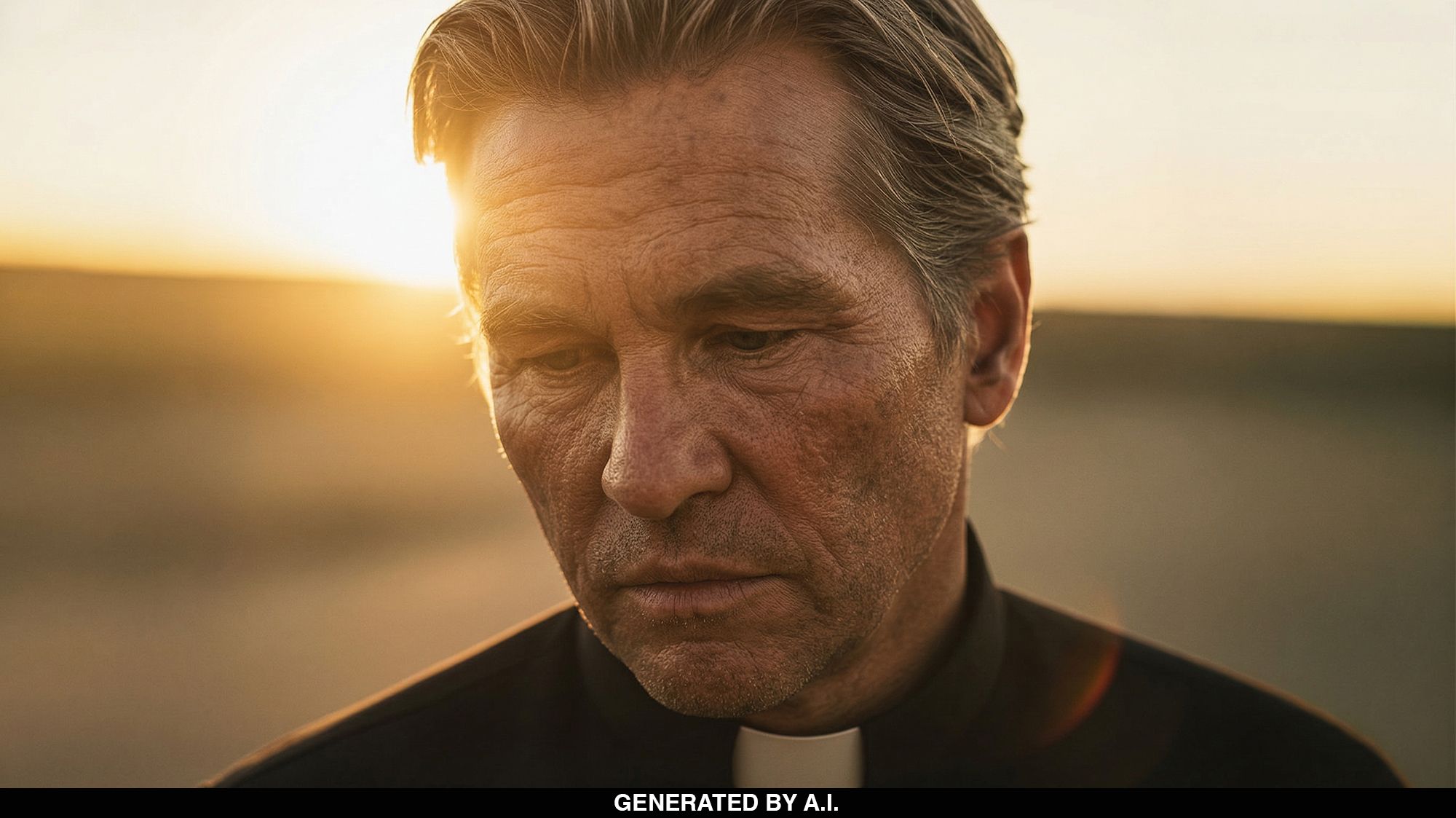
A famous actor appears onscreen, captured in the midst of an intense scene with several children. The camera lingers on the characters’ faces, trying to soak up their emotions and reactions. Except these figures aren’t human: All of them are AI-generated creations.
I’m sitting in downtown Los Angeles with independent filmmakers Coerte and John Voorhees, watching snippets of their movie As Deep as the Grave. It features the late Val Kilmer, who signed on to star in the film years ago but died in 2025, before he could shoot a single frame.
The Voorhees brothers are showing me performances conjured entirely from a handful of personal photos and audio recordings given to them by Kilmer’s estate. They’ve molded these digitized artifacts into an array of Vals: young Val, middle-aged Val, elderly Val. The footage skirts around the uncanny valley, but something about it still feels eerily smooth.
“There’s always roles that speak to actors, that are incredibly personal, and this was one of those for Val,” says Coerte. And Kilmer wouldn’t have been able to participate in As Deep as the Grave without AI.
Almost a decade ago, Coerte began writing a script for a movie about Ann and Earl Morris, married archeologists who devoted their lives to unearthing Navajo history in the American Southwest. He cast Abigail Lawrie and Tom Felton as the couple, and Kilmer as Father Fintan, a Catholic priest with close ties to the Native American community.
Kilmer felt a deep kinship with Native peoples, claiming Cherokee heritage and even playing a part-Sioux character in the 1992 movie Thunderheart. But by the time As Deep as the Grave began shooting, Kilmer was too sick to work: Two tracheotomies and treatment for throat cancer had decimated his voice and left his health fragile. So Coerte reluctantly wrote Kilmer’s character out of the script. But then his tech-savvy brother, John, convinced him to revive Kilmer with AI; after all, John knew that the actor had created an AI-generated speaking voice (though AI evidently wasn’t used to dub his much-commented-upon performance in Top Gun: Maverick). Why couldn’t As Deep as the Grave do something similar?
The Voorheeses’ project is stoking anxiety in Hollywood among insiders who see it as a sobering harbinger of a dystopian future. In recent years, we’ve seen digital trickery employed to include the late Carrie Fisher in The Rise of Skywalker and insert a younger version of the actor into Rogue One, and to simulate Anthony Bourdain’s voice in the documentary Roadrunner. But as the technology improves exponentially, many in Hollywood are starting to feel increasingly jittery about where all this is leading—and about the prospect of a battle brewing over famous dead bodies.
Could a late famous actor’s careful career choices and dedicated artistry soon be soiled by posthumous AI slop? Might entire generations of potential stars be eclipsed by the unnaturally prolonged radiance of AI ghosts, superstars who refuse to stay in the past? Are we hurtling toward a world of ghost-ploitation?
The actors union, SAG-AFTRA, has been grappling with these questions—as well as the general economic threat of AI—for several years now. On June 4, its members ratified a four-year contract with the studios that added a new provision for negotiating the use of synthetic AI performers like Tilly Norwood, adding to a previous provision which requires anyone using an actor’s digital replica to get that actor’s permission and pay the human actor union rates for the creation and use of the digital replica.
This is a crucial moment for building guardrails around AI use in the industry, including both synthetic creations and digital replicas of real actors, living and dead. “Prior to this technology, even if a performer agreed to do something, they had to actually do it in order for it to be usable,” says Duncan Crabtree-Ireland, SAG-AFTRA’s executive director. “Now all a producer needs is to have sufficient data assets to create a digital replica. So we felt it was really, really important to make sure that the consent element of that was fully informed.”
Some union members might’ve preferred to ban the use of dead actors’ AI replicas altogether. But “the reality is that a lot of our members spend a lifetime building up a persona that has real value,” says Crabtree-Ireland—“not only to themselves but to their families. And so we ultimately concluded that we wanted to leave that decision in the hands of the performer and their family.”
Kilmer’s estate granted permission to use his likeness in As Deep as the Grave. “It’s such a unique situation with my father, because he wasn’t able to physically perform,” says Kilmer’s daughter, Mercedes. “He was too sick, but he still wanted to do it.” The actor lived in New Mexico for nearly two decades. “I think bringing tax credits to New Mexico was really important to him,” she says.
Mercedes is a musician who has plenty of qualms about AI and the havoc it’s wreaking on education and the job market. She says Kilmer’s estate won’t grant permission to use AI versions of her father in other projects. But she is happy that his involvement in As Deep as the Grave may help set a precedent for performers: “Less established film actors can point to this and say, ‘We deserve to be compensated for an AI performance on par with physical performance.’”
Although an AI replica might now get the same fee as a corporeal performer, using the replica can still save a lot of time and money. Instead of having to pay a crew for a week’s work in the New Mexico sun, the Voorheeses created new scenes with Kilmer entirely using AI. In some of them, Kilmer’s character even speaks an authentic 1920s version of the Navajo language, although the actor himself didn’t speak the language when he was alive.
“As independent filmmakers, it’s the most freeing thing,” Coerte says. “I love working with talent. But AI allows us to really reduce the elements that make it so complicated and expensive to tell a story. My friends feel lucky if they get one movie or one pilot a year. If you’re working with filmmakers of the modern era, you’re gonna be able to make 10 feature films a year.” John believes that the traditional way of making films—shooting on a set with a human cast and crew—is going to become “a niche, bespoke thing, like theater productions.” As Deep as the Grave’s production process, meanwhile, will become the norm.
To an AI skeptic, the Voorhees brothers’ manic enthusiasm for this tech can feel chilling. “One of the best things you learn very quickly is to actually just let the AI do as much of it on its own as possible,” Coerte raves. “It often comes up with even better ideas than you come up with. It’s trained on the best of everything.” The duo walks me through some of the steps they took to transform an old photo of Kilmer into a walking, talking cinematic character. From what I see, this performance wouldn’t exactly win him an Oscar—and thanks to the Academy’s new rule stating that acting nominations must be “demonstrably performed by humans with their consent,” it wouldn’t be eligible anyway.
In life, Kilmer took his craft very seriously, to the point of being labeled “difficult” within the industry. (“In an unflinching attempt to empower directors, actors and other collaborators to honor the truth and essence of each project…I had been deemed difficult and alienated the head of every major studio,” he wrote in his 2020 memoir, I’m Your Huckleberry.) Isn’t AI taking away the very thing he cared about most: the human artistry inherent in acting?
Maybe. But Coerte insists that he spent a lot of time studying Kilmer’s many screen performances to get his virtual version right. “You start to pick up on the mannerisms, and I made a list: What are Val’s unique things he does when he’s angry, when he’s happy, when he’s upset? So I’m cataloging all of his different emotional states and then using them, depending on what the scene requires.”
Mercedes sees the AI replica as something else altogether. “My dad looked at it as an animation that was really accurate, and he did not think of that as comparable to acting,” she says. Allowing filmmakers to feed his image and voice into an AI agent was a way for him to stay in the game as his body failed him. “In every area of life, my dad would not accept that there were limitations. He’d be like, ‘What do you mean I can’t talk? Let’s find a way to make me talk.’”
Digital specters and holograms have haunted our cultural dreams and nightmares for decades now. One of the most entertaining takes on the topic came in Black Mirror’s 2023 episode “Joan Is Awful,” in which a woman (Annie Murphy) discovers that she has signed away the rights to her likeness, which a streamer exploits by casting a CGI Salma Hayek as the woman’s TV alter ego. Creator Charlie Brooker had initially been inspired by the rise of deepfakes—but he realized that his script spoke to the actors involved in a way he hadn’t anticipated.
“This is stuff that they’re already being confronted with and thinking about—how to have control over their own image and where that goes,” Brooker told me at the time. “It must be terrifying for the next generation of actors coming up. Are you suddenly going to be competing against all the Golden Age actors that have ever been popular? If you can keep casting Jennifer Lawrence or Tom Hanks in things forever and ever and ever, I can see that being a concern.”
Some entertainment industry insiders believe that fear is overblown. “At the end of the day, consumers are going to decide what they want, and I don’t think consumers will want the same person in everything,” says Alexandra Shannon, the head of strategic business development at talent agency CAA. Crabtree-Ireland thinks that having digital replicas perform crucial scenes in major movies is still a way off. “I don’t think anyone would have been as excited to see digital replicas of Meryl Streep, Anne Hathaway, Emily Blunt, and Stanley Tucci in The Devil Wears Prada 2, right?”
That hasn’t stopped plenty of actors from expressing despair about AI. “Good Lord, we’re screwed,” Blunt said last fall, when first confronted with Tilly Norwood. “That is really, really scary.” At a press conference this spring, Hannah Einbinder cursed those who want to inject AI into the artistic process. “They’re trying to rob real creative people of our gifts. And you can’t. And even if you try, you will never be cool.”
Earlier this year, Cate Blanchett, Scarlett Johansson, Joseph Gordon-Levitt, and hundreds of other performers threw their support behind Stealing Isn’t Innovation, an initiative launched by the Human Artistry Campaign to protest AI’s unauthorized use of copyrighted material. Blanchett also cofounded the nonprofit RSL Media, which later this month is launching a public registry that will allow creatives to specifically grant or withhold AI permissions.
“The project really started out of absolute frustration and terror,” says RSL cofounder Nikki Hexum. Her husband is a musician, her daughters are actors, and she shudders at what might happen to their work in an AI-driven future without clear rights for creators. “There are tons of bots scraping everything that they find on the internet and basically feeding it to learning models.”
Pirating has been a music industry issue for decades, and it’s increasingly threatening authors as well. That’s why RSL’s registry is designed to serve all creatives. “It turned out there was a really important missing structure, which [is specifying permission] and turning that into a machine-readable piece of code that the bot then understands,” Hexum says. “So we’re providing the infrastructure layer that allows people to register their consent.” Entertainment industry leaders are also working with policymakers on legislation like the NO FAKES Act, which aims to “protect the voice and visual likeness of all individuals from unauthorized computer-generated recreations from generative artificial intelligence (AI) and other technologies.”
Using a person’s voice or likeness after death without permission is a form of “digital grave robbing,” Hexum says. “Instead of taking jewelry or bones, though, it’s taking something that was deeply personal. The idea that that could be dug up and sold and made to perform words that they would never have chosen to use raises very serious ethical questions. Did the person agree to this when they are alive? Who gets to decide what their voice says now? Who profits from it? Does the AI version honor who they were?”
It will be a while before we see whether As Deep as the Grave honors Kilmer’s legacy, since the film is still being completed and doesn’t yet have a distributor. But the desire to bring dead celebs to life isn’t going away; just ask the ghosts of Tupac and Ozzy Osbourne.
The prospect of a world where art and entertainment are disconnected from human presence is nauseating. And as AI technology continues to improve, the queasy questions swirling around it will only multiply. “I’m hoping that this is the beginning of a very thoughtful conversation,” Hexum says. “But we will probably fuck it up before we make it right, because we’re human.”
Trump’s Dangerously Absurd Quest to Seize Greenland Was the Start of a Worldwide Rampage
Searching for the Victims—and Answers—After the July 4 Flood That Devastated Texas
Ta-Nehisi Coates on the Next Black President
The Fever Breaks! Knicks Clinch a Championship and New York City Comes Alive
Exclusive: Trouble Behind the Scenes at Alex Cooper’s Media Empire
Meet Your New Defense Contractors: The DOGE Boys
Prince William, Kate Middleton, and the Rage Over Royal Real Estate
How Angelina Jolie’s Six Kids Are Taking on Adulthood
Here are the 25 best movies to watch on Netflix this June
Check out this article: How a Real-Estate Scuffle Turned into a True Tale of Miami Vice