JD Vance, Conservative Voices, and Gen Z Nuns: The March for Life's Next Chapter After Charlie Kirk | Vanity Fair
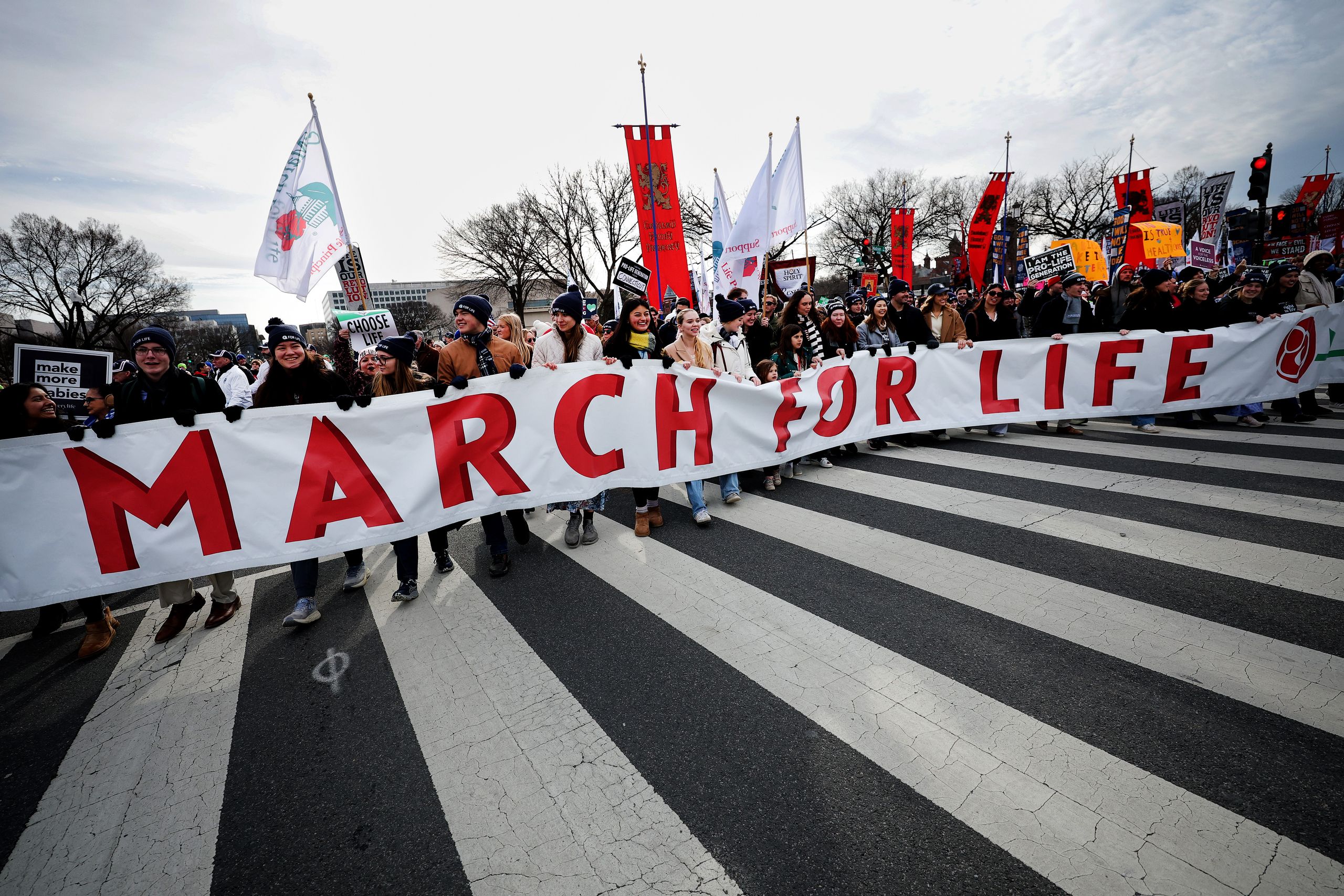
At the annual March for Life in Washington, DC on Friday, a “hello pro-life America” chant grows as bobble hats, ear muffs and Charlie Kirk signs accumulate. To my left, a man in a gray suit with a cobalt blue mullet scrolls Google, searching for the definition of “euthanasia.” On my right, a gaggle of teenage boys workshop an ICE jingle while one of them beatboxes. Vice President JD Vance will speak, thousands are expected, and to top it all off, a major snowstorm is rolling in.
In the wake of Kirk’s death last September, this year's march reflects a heightened urgency to make abortion a political priority. Kirk heavily advocated for the pro-life movement, saying, 'it's not enough to be against abortion; we have to actually help women choose life,' a stance his widow, Erika, now the CEO of Turning Point USA, the conservative organization her late husband created, has continued to espouse in public events. Now, Kirk's influence is palpable as young people from Turning Point USA, Students For Life, and Counteract USA, among other groups, mobilize at the March for Life.
And with Vance, a potential 2028 presidential candidate, aligning himself so closely with the pro-life movement, there’s little ambiguity throughout the day about where attendees' votes will eventually land.
People hold a Charlie Kirk sign as they march in the 53rd annual March for Life rally in Washington, DC, on January 23, 2026.
“We're here because life begins at conception,” Lily, a 17-year-old from Chicago, tells me. “We're here to save all the babies, and we won't stop coming until till abortion is ended.” She has traveled with peers from St. James at Sag Bridge Catholic Church in Illinois and lands, without hesitation, on Kirk and Candace Owens being her role models.
In the background, Christian music plays out across the capitol grounds as the crowd enjoys the rally and performances that are a prelude to the march. Like much of the young conservative activism circuit, it’s similar to a festival, with entertainment and celebrations drawing out over a few days.
Signs of the annual rally, which has been held in Washington since 1974, when it started as a protest against Roe v. Wade, began when I stepped off the Amtrak at DC’s Union Station on Thursday. Looking up at the vaulted marble ceiling, it was almost easy to miss the group of people being siphoned off from the train behind a wall decorated with grass into a private networking event for The White Rose Resistance. The group, who call themselves a nationwide movement with a mission to be “a voice for unborn children,” share their name with the nonviolent German resistance group led by Hans and Sophie Scholl against the Nazis.
People attend the annual March for Life rally on January 23, 2026 in Washington, DC.
That night, a prayer vigil was held. On Friday morning, there was a Capitol Hill breakfast, where Congressman Nathaniel Moran spoke alongside other politicians and Bishop Joseph Strickland. Following the event was The Rose Gala Dinner and “Pour la Vie: For Life,” a cocktail reception for young professionals. And conservative influencers like Isabel Brown, Beni Rae Harmony, and Caroline Joyous were “under contract with March for Life,” meaning for the duration of the day they posted sponsored content about the event.
“I'm here because I recognize that a third of my generation, people who could be doctors and lawyers and people who are productive to society, were brutally murdered and ripped apart in the womb,” Zeke, a 19-year-old from Arkansas, tells me back at the rally. Like many, he and his five-man group are carrying a sign with that statistic. Others around me say things like “Dump your pro-choice girlfriend,” and “feel my heart beat to the beat of the drum,” a play on the 2012 Kesha song “Die Young,” featuring an ultrasound with some pink scribbles.
“I think a woman's choice for [her] own body does not give her the right to interfere with the right of life,” Zeke adds. “I grew up in a conservative household and my mother actually had an abortion before she was married to my father. That was probably one of the most important influences of my perspective, is watching her grief.”
Vice President JD Vance delivers remarks during the annual March for Life rally on the National Mall on January 23, 2026 in Washington, DC.
After a promotional video of young, blond children singing plays on the screens on the National Mall, the crowd cycles through the national anthem and a couple of prayers. Vance then appears on stage behind bulletproof glass. “The mark of barbarism is that we treat babies like inconveniences to be discarded,” he says, delivering a graphic anecdote about the ancient pagan world that visibly shakes the under twenties contingent. “Save the baby humans and the turtles,” a girl wearing a small diamante cross whispers to her pack of friends behind me. The group erupts at each intonation.
At the end of his speech, Vance responds to muffled shouts from the audience, addressing what he called the elephant in the room, or “a fear that some of you have that not enough progress is being made.”
“I hear you, and I understand,” he says, adding, “We are going to continue to make strides over the next three years to come.” A pre-recorded video of President Donald Trump is followed by a similar one from Senator John Thune and next Speaker of the House Mike Johnson appears on stage. “Our rights do not derive from the government, our rights derive from God himself,” Johnson says. “We need to remind people that.” The lineup of speakers is almost identical to the event last year.
President Donald J. Trump speaks via video link to the crowd gathered for the annual March for Life rally on the National Mall in Washington, DC, on January 23, 2026.
By 2 p.m., speeches wind down and the march is off to a later-than-anticipated start. Young children cling to their parents' puffer jackets, sad to be moved from their places on the floor. “This won't be on the news, it won't be on the regular news,” a lady warns her friends somewhere behind me. In front, Gen Z nuns gush about a man who approached the group last week. “I haven’t told mother or sister,” exhales the one in a North Face jacket and low-rise Doc Martens.
The drums start, and the crowds drift down Constitution Avenue towards the Supreme Court. Protestors are visible amongst the perimeters, but there isn’t much noise. Anything they say is shut down pretty quickly. Two friends, a 17-year-old and a fifteen-year-old tell me they’ve driven eleven hours from Fort Wayne, Indiana. When I ask them why, they say “common sense.”
People dance and sing outside the U.S. Supreme Court during the annual March for Life rally on January 23, 2026 in Washington, DC.
With an hour still remaining of the annual gathering, focus turns to next year. One group, who have traveled from Missouri, Tennessee, New York and Texas warn they usually plan travel and accommodation a year in advance. The train ride back to New York, however, is markedly calmer. Cars that had been filled with marchers thin out along the route, and by the time the train reaches Penn Station, most of their signs have been abandoned or disappeared.
Inside the Dramatic Arrest of an Olympic Snowboarder Turned America’s Most Wanted
The 11 Biggest Oscar Nomination Snubs and Surprises
The Race Is On: See All the 2026 Oscar Nominations
Meet Alexis Wilkins, the Zoomer First Lady of the FBI
Oscar Nominee Teyana Taylor on Her Breakout Year
Heated Rivalry: How to Mint Two Stars in 60 Days or Less
Why We Can’t Let Go of John F. Kennedy Jr. and Carolyn Bessette-Kennedy
The Life—and Shocking Murder—of Playboy Playmate Dorothy Stratten
Belle Burden On Her Family’s “Legacy of Infidelity”
Susie Wiles, JD Vance, and the “Junkyard Dogs”: The White House Chief of Staff On Trump’s Second Term
From the Archive: The Serial Killer and the Texas Mom Who Stopped Him