Behind the Lens: Christopher Anderson's White House Photography | Vanity Fair
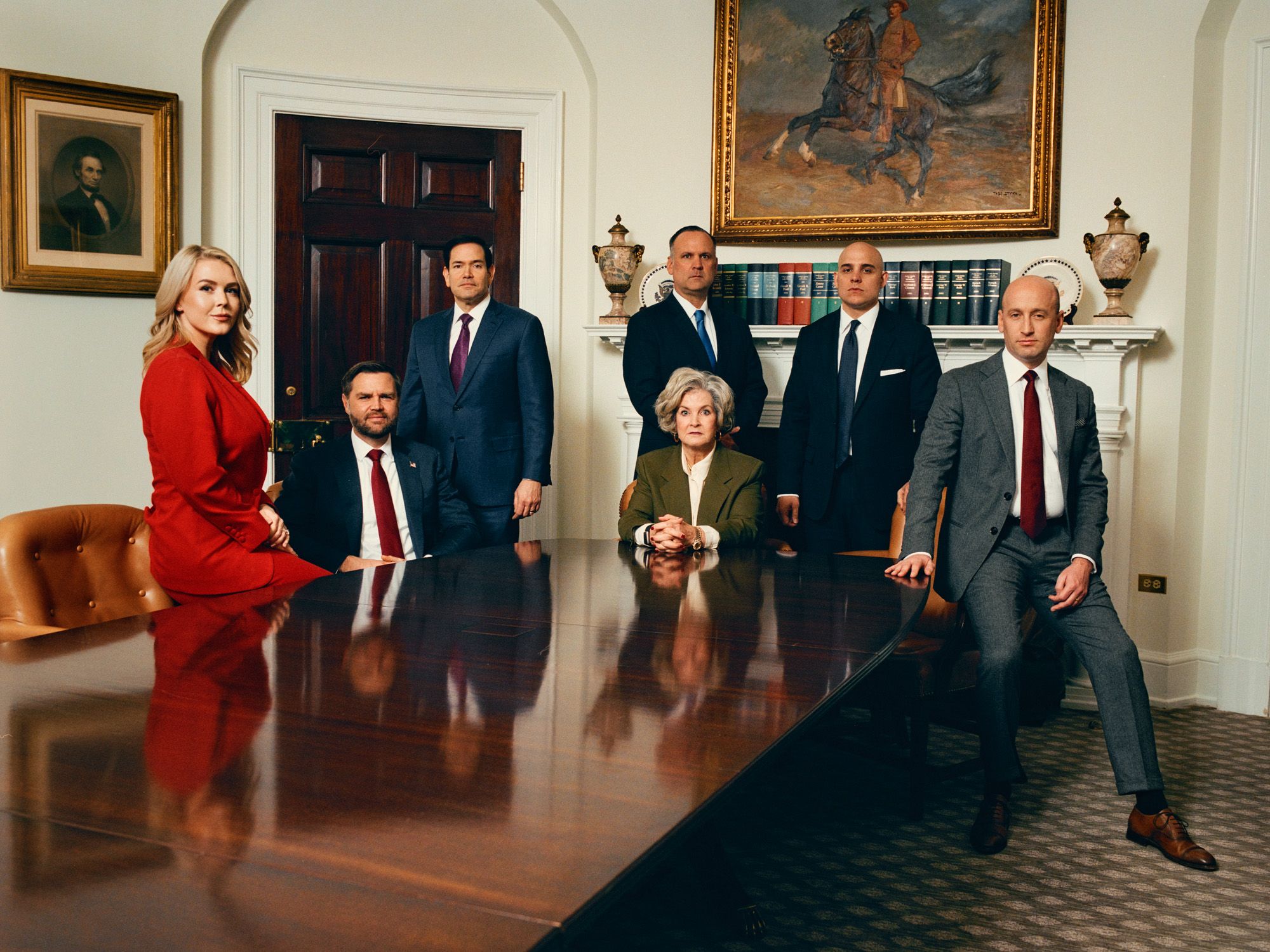
The White House isn't just the home of the sitting president of the United States—it's also known as the people's house, a symbol of democracy at work. Vanity Fair's Chris Whipple took readers inside the building and the inner workings of a half-dozen of Donald Trump's closest advisors, interviewing chief of staff Susie Wiles several times throughout the first months of Trump's second term, and speaking to Stephen Miller, Marco Rubio, Karoline Leavitt, JD Vance, and others in a bombshell two-part feature.
Whipple has discussed his reporting process for the story, and now, here's Anderson in conversation with VF, taking us behind the scenes of the assignment that he almost turned down. And, to answer the question on everyone's mind right away, Anderson says of those ultra-tight shots, “No, they're not cropped versions. I'm standing very, very close.”
Vanity Fair: What compelled you to take this assignment for Vanity Fair?Christopher Anderson: I wasn't eager to accept the assignment at first. My roots are in journalism, I have done a lot of political work over the years and photographed a lot of politicians from the last administrations, from George Bush to Barack Obama, Joe Biden, even Bill Clinton. But a lot of what I do now is photograph celebrities. And I assumed incorrectly that the ask was for me to show up and be a celebrity photographer for this administration. And my journalistic DNA would not sit comfortably with this idea. So I thought, at first, I'm not gonna accept. Jennifer Pastore, the global creative director of Vanity Fair, and I had a long discussion about this, and she persuaded me that wearing my celebrity photographer hat was not why they were coming to me. That the qualification for this job was to come as a journalist, to bring a certain sense of clear-eyed observation and even skepticism. And that would come with a certain challenge and in my opinion, I felt an enormous responsibility in doing that. So that very much aligned with what my history is, what my roots have been in, it's an historical moment, so I want to be there.
You have photographed many politicians for various publications over the years. What are some of your most memorable experiences?I've spent a lot of time photographing politicians over the years, I did a book about US politics. I photographed presidents, both American and French, and from other places. It's been very much a part of my work looking at politics with a critical eye. Not just one side versus the other, but actually I think part of my work is about examining the theater of politics. And yeah, there've been memorable experiences from flying around on presidential planes and observing sort of behind the scenes in many different administrations. I've been into the White House in three different administrations now. To see the difference in how the atmosphere is, how the vibe is in each one of those situations, is fascinating. And to kind of peer behind the curtain of such a power and such a mechanism is interesting.
Let's talk about the first time you went into the White House.I did one of the last—maybe the last—portrait sitting of Barack Obama in the White House at the end of his term, and I did the first portrait sitting of Donald Trump during his first term in the White House. So those portraits that I made in the White House were only a few months apart. And the difference between those two White Houses, the atmosphere, the vibe, the temperature of the room, was quite noticeable.
What was the most striking aspect of your day with Susie Wiles and the team?There were interesting moments during the day. For instance, at one point our schedule—we spent the entire day there and we had scheduled moments with each one of the players throughout the day in their office to take the pictures—and at one point in the middle of the day the schedule got completely thrown off because we were told that the Cabinet had been called to the Situation Room. And it was, you know, we wonder if the Situation Room is used when things like going to war are taking place. So we, together with the Vanity Fair team, were speculating while we were waiting for what could possibly be happening. We later found out that day that it was Congresswoman Lauren Boebert who had been called into the Situation Room to put pressure on her about not pushing to release the Epstein files, so to speak. That was an interesting one.
What is the encounter you remember most? For me the most interesting encounter for the day was with Stephen Miller. I find him to be a really interesting character on many levels, both at this moment in time and just what he represents and how he carries himself. He's not someone who's been photographed a lot in this way. So he was clearly a little bit nervous about sitting for a portrait, and he asked a lot of questions. “Why are you doing this? Why are you shooting film as opposed to shooting digital? Why do you know what that thing does? And how does it look? How am I? How do I look sitting here? Does it look like I'm slouching?” And at one point, I said to him, “you know, the people may say a lot of things about you, but slouching is not one of the things they will accuse you of.” And at the end of the session he comes up to me to say goodbye, and he says, “You know, you have a lot of power in the discretion you use to be kind to people,” meaning kind to people in my pictures. And I looked at him, and I said, “Yeah, you know, you do too.” It was interesting to me, his reaction. But just being in that place is in itself a fascinating experience, to be kind of within the halls of that kind of power, but yet to see it that it is a little bit [like] the Wizard of Oz behind the curtain. The place is small and shabby and you see paint marks on the wall, the wiring is done in a shabby way, and the desks can be messy, and it's—I guess it's a little bit like looking at middle management at a lot of companies.
How much time did you spend with each of the people that you portrayed? Each session ranged from 15 minutes to 35 or 40 minutes with [each] one. I think I spent a little bit more time with Marco Rubio, for instance. And then we had them, at one point, all come to the Roosevelt Room, where we did a group portrait with all of them, which also took about 30 minutes because I did two separate setups of a group portrait.
Did anyone ask to see the pictures you shot? No one really asked to see the pictures, which I was a little bit surprised about because that's been my experience around politicians before. But I was shooting mostly on film, so there was not really any way to show them pictures, had I wanted to.
How far did you shoot them from? We did many things. As you see in the magazine, some of the pictures are more formal [and shot] from a certain distance, normal portrait distance from the photograph, where you get a sense of the environment, a context of what their space looks like, which was also important for me to show. I wanted to give a sense of what it feels like in their office. The exposed wiring, the paint job of the walls, the art, the things they chose to put in their office. It's interesting, it's fascinating. And then I also, at the same time, would move in to do the very tight portraits. And I stand very, very close to them when I do this. So it's not like I was hiding what I was doing. I was physically standing so very close that even Susie Wiles at one point said to me, “You're too close.” And I backed up. So no, they're not cropped versions. I'm standing very, very close.
Susie Wiles, chief of staff to Donald Trump.
Marco Rubio.
Stephen Miller.
How did you marry your photography to the text by Chris Whipple? I had not read Chris Whipple's story the day before because it wasn't finished, but Chris was there on the photo shoot. And we discussed a lot about what kind of reporting the story would be. I knew vaguely what the story was about, if not all the precise details. But I don't see it as my job to illustrate a story. I am there as a journalist in my own right, as sort of the eyes of the public, to go in and observe and see what I see. I'm trying to do that in a way that's as observational as I can. I feel like my job is to offer the viewer the point of view of what I experienced in that moment. I feel like I'm a professional noticer. And I go in to observe and be the eyes for the public in that sense. My job is not to decorate a magazine, it's to show the viewers what the experience was.
And so you said that you've already photographed President Trump, would you do it again? Would I photograph President Trump again? Oh, absolutely. Would he let me photograph him again? That's another question. I did the close-up face on him as well. I photographed him very, very closely. Being physically close to a president with a camera is a strange experience. He's surrounded by Secret Service guards, and just being physically that close is uncomfortable, probably for him as well as for me, but for everyone. So when I photographed President Trump very closely, it took a little bit of a chess match to be able to get myself physically that close, even though he was there sitting for me as a subject.
Donald Trump photographed by Christopher Anderson for New York Times Magazine.
How have you felt about the reactions to the photos?Did we break the internet? I don't even know where to begin to answer that. The internet is a strange place. Surely I expected there to be some reaction. I could never have imagined the level of interest. The internet has a mind of its own and it latches on to certain things. I don't know if any of that has to do with me as much as it has to do with timing, with where America is right now, with the state of the media right now. So maybe there's something in that, and people are connecting with that, or reacting to that in ways that I could have never have envisioned.
Marco Rubio briefly changed his profile picture to one of the pictures you made.You're kidding me. Impressive. Respect. Respect.
Vance said that he owes you $1,000…JD Vance made a joke as we were photographing him. He said something like, “I'll give you a hundred bucks for everyone you make look shittier than me. And you know, a thousand bucks if it's Marco.” And at the moment, we all kinda laughed. But then later, when we came in for the group picture, I said to all the rest of them, “By the way, the vice president offered me a hundred bucks for every one of you that I made look worse than him.” And as they were leaving the room, I joked with him and I said, “You know what, you owe me a few hundred bucks,” and he goes, “Yeah, yeah, yeah, it's in the mail.”
Vice President JD Vance.
One of the most talked about images is Karoline Leavitt’s and the injection marks you can see on her lips.I don't believe in shaming anyone for their physical appearance. But she makes choices in how she presents herself and in how she alters her physical appearance that she presents to the world. I made a choice in photographing her choices in a way that is revealing about her choices. And I didn't—I chose not to remove those things you see in the picture or to hide them or to minimize them.
Karoline Leavitt, White House press secretary.
Is there anything that the internet's comments have made you realize about your pictures?There's one art historian on the internet who keeps doing more updates of what she sees in the photos and it's fascinating: composition references to historical paintings, all these things I'm endlessly entertained by. I didn't plan on starting the discussion, but there is a discussion at this moment about what the photographic image means purely in this day and age of AI, of social media, of filters, how we present ourselves and sort of the whole discussion and perspective around the image and the photograph. And it's fascinating for me to watch that play out on the internet. Maybe we have sort of become a—we've fallen asleep at the idea of what a photograph is and what a public image is. And watching that discussion play out on the internet, that's been pretty fascinating.
Is there anything the readers haven’t yet noticed in your pictures?There's the one Easter egg that I hoped people might see, and maybe they are starting to see a little bit, is that I had Stephen Miller sit underneath one of the oil paintings in the Roosevelt Room that is a beautiful depiction of Native Americans crossing a river on horseback to return to their teepee village home. It was one of those things that—I found it to be kind of interesting and maybe incongruous, that I thought might be picked up on. Go look, go look for it.
Stephen Miller, deputy White House chief of staff.
How did you choose the pictures, between very posed portraits and more on-the-spot images ?I photographed everybody in many ways, both in sort of more formal controlled portraiture positions as well as the unguarded moments that I was witnessing while I was there in the West Wing. That was the job, I felt, was to observe my experience there and communicate something about that. Why I chose those things? Now we get into weird territory about what is the meaning of photography and all these kinds of things of how a photograph chooses a particular moment that speaks a greater truth or is in some ways revelatory about my overall experience there or what I witnessed there, of the situation. It's an imprecise science, or, I hesitate to use the word art, but it is what I find interesting about photography. Photography, to me, is not necessarily about making something look pretty, it's about seeing and observing and communicating something about an experience.
Susie Wiles
Karoline Leavitt
JD Vance
Marco Rubio
And who is the next politician that you would like to photograph? Rosalía. [laughing] There's another internet discussion that I find interesting: Yes, I have photographed and I do photograph celebrities sometimes very close. There's a picture of Rosalía, she's very close, and some of the internet discussion is like, “Oh, but you don't see her pores and her makeup mistakes.” And yes, it's true: she's a celebrity. I'm not there to photograph her for the same reason, in the same context, as I am there when I go to the West Wing as a journalist. She's a performer and she doesn't have the responsibility on her shoulders for the well-being of millions of people. And that is a big difference. These people are civil servants, she's an entertainer, and the context is totally different. So I photographed her in a different way. And her skin happens to be nicer than Marco Rubio's.
Susie Wiles, JD Vance, and the “Junkyard Dogs”: The White House Chief of Staff On Trump’s Second Term (Part 1 of 2)
Susie Wiles Talks Epstein Files, Pete Hegseth’s War Tactics, Retribution, and More (Part 2 of 2)
11 Disgusting Things From the Latest Epstein Files Drop
Vanity Fair Goes to the White House: Trump 2.0 Edition
The Children of MAGA Speak Their Minds
Donald Trump’s Reported Health Issues, Examined
Even Christians Have Had Enough of Ballerina Farm
Getting Intimate With Heated Rivalry’s Connor Storrie and Hudson Williams
Meet the 11 Best Movies of 2025
From the Archive: Behind the Mysteries of Capote’s Swans Scandal