A Rising Blue Wave: Will Democrats Maintain the Momentum? | Vanity Fair
President Donald Trump is increasingly underwater in nearly every lane of the polling pool, from net approval nationwide (minus 18); up in Alaska and down in Florida (both roughly minus six); and from the olds (minus 10) to the youngs (minus 35). Even a majority of white people disapprove of the job Trump is doing.
Americans are unhappy about the economy; ICE is shooting people in the street; Republicans are losing special elections in traditional strongholds, including Louisiana.
All of which seems like the perfect setup for a midterm blue wave in November. So, naturally, the Democrats will screw it up. The question is how?
“Democrats are gonna Democrat, right?” Amanda Litman says. “We do have a tendency to steal defeat from the jaws of victory.” She is a cofounder and the president of Run for Something, a progressive group that recruits younger and more diverse Democrats to, well, run for something. And Litman is actually optimistic, if cautiously so.
Democrat control of the House and Senate hinges on about two dozen races. Each will have its own idiosyncrasies. Then there is Trump’s assault on the election process itself, for which the Democrats appear woefully underprepared. But the encouraging midterm trends could also be threatened by unforced internal errors.
Nominate boring candidates
Voters may be souring on Trump. It sure doesn’t mean they suddenly love the Democrats. The party is still seen as weak on immigration, untrustworthy on the economy, and too woke. “Yeah, the Democrats are against Trump, but they aren’t seen as standing for anything,” says Mike Madrid, a Republican strategist who was a cofounder of the anti-Trump Lincoln Project.
That’s why nominating another batch of respectable but unexceptional candidates—the preference of the party’s DC establishment—could be deadly. And in that respect the primary season is already off to a fascinating start. Last week Analilia Mejia, a left-wing activist and first-time candidate, pulled off a stunning upset in New Jersey’s Democratic primary, edging past former congressman Tom Malinowski and winning a special election.
It’s tempting to overinterpret Mejia’s victory, but the race was a weird one: Eleven candidates were vying to become the successor to former representative Mikie Sherrill, who has moved up to become New Jersey’s governor, and AIPAC, the powerful pro-Israel lobby, dumped millions of dollars into trying to weaken Malinowski.
Analilia Mejia speaks to supporters and members of the media at Paper Plane Coffee Co. in Montclair, New Jersey, January 29, 2026.
What’s unmistakable, though, is that Mejia was a charismatic outsider with a distinct message: She wants to abolish ICE. Voters often reward candidates who have energy and clear principles, even if they don’t always entirely agree with the ideology behind the policy goals. See, for another recent example, Zohran Mamdani’s victory to become mayor of New York City.
The primary season stretches all the way until the middle of September, giving the Democrats many chances to choose between conventional and upstart candidates. The highest-profile contest will be in Maine, where the leading contenders to take on Republican incumbent senator Susan Collins are 41-year-old veteran, oyster farmer, and tattoo enthusiast Graham Platner and 78-year-old governor Janet Mills, who was strenuously recruited into the race by Chuck Schumer.
“I think being the chosen candidate of establishment Democrats is a bad thing this year,” Litman says. “Democratic primary voters want to throw the bums out, and anyone associated with the bums also has to go.”
Become overconfident and complacent
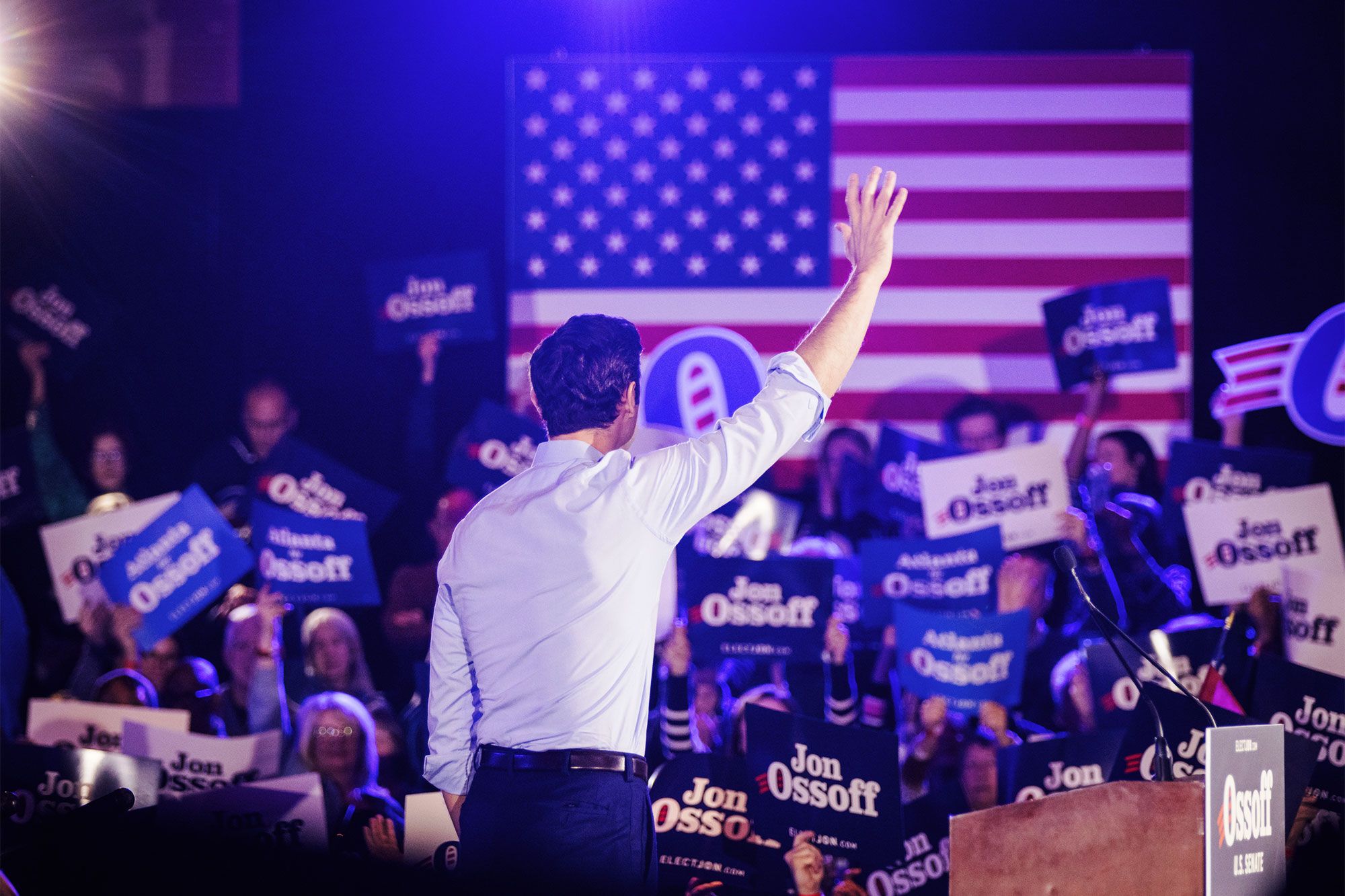
Jon Ossoff is the hot new name in the 2028 Democratic presidential-nomination speculation game. But Ossoff could well lose his 2026 reelection run as a US senator from Georgia.
That’s just one example of how getting caught up in wishful thinking could divert attention from the grunt work needed to not simply win back majorities this fall, but to seize the chance to win big. “One danger is that the Democrats are mispositioned to make this a sea change election,” says Cornell Belcher, a strategist who worked on both of Barack Obama’s winning White House runs and who was one of the few people to correctly foresee that the 2022 midterms would not produce a red wave. “It’s not just talking about affordability. It’s doing the structural work on the ground of registration and social media to turn out voters, like the Republicans did in rural Georgia in 2024.”
Graham Platner speaks at a town hall at the Leavitt Theater on October 22, 2025 in Ogunquit, Maine.
Get massively outspent
The Republicans have deep-pocketed right-wing donors and the Trump cult of personality going for them. The Democrats have a hangover from raising more than a billion dollars in 2024, only to lose. The bottom line is a nearly $200 million funding chasm, with major Republican groups holding more than double the cash of the equivalent Democrat groups so far, according to The New York Times.
That’s bad, right? “It’s a bit of an open question,” says Bradley Tusk, a venture capitalist and political consultant who managed Mike Bloomberg’s third winning mayoral campaign. He points to last year’s New York City mayoral race as an example. Andrew Cuomo’s side spent some $66 million, versus $24 million for Mamdani—“and it didn’t matter at all,” Tusk says. Having more money is still better than having less, though, and Democratic donations rose in December and January. Last week the Democratic National Committee, trying to compensate for the fundraising gap, launched a new $1.8 million effort to train and deploy midterm campaign operatives. 'Democrats will keep winning because we’ll keep showing up and making a clear case to voters on the ground,' DNC chairman Ken Martin tells me. 'We’ll be supporting 10,000 campaigns across the map, and while we’re confident, we’re not complacent.”
Waste money on fantasies
Jasmine Crockett is an attention magnet. James Talarico is a nice young man. Together, the two candidates in the Texas Democratic Senate primary might add up to the next Beto O’Rourke.
True, Dems just won a state legislature special election in a district Trump took by 17 points last year. And sure, there’s a scenario in which Texas Republicans nominate MAGA favorite Ken Paxton for senate instead of the incumbent, relatively moderate John Cornyn, providing whoever turns out to be the Democratic nominee with a slightly better shot. But Texas remains a deep-red white whale. No Democrat has won a statewide office since 1994; Trump beat Kamala Harris in Texas by nearly 14 points.
If Democratic donors want to wager on a Deep South long shot this time around, maybe they should look at Mississippi. True, Republican Cindy Hyde-Smith won by a solid 10 points six years ago, but state Democrats made sizable gains last fall. Two intriguing Democrats—Scott Colom, a local district attorney, and Priscilla Williams Till, a cousin of Emmett Till—are running in the primary to challenge Hyde-Smith, hoping to capitalize on the state’s high percentage of Black voters.
And in Mississippi’s Third Congressional District, which includes the college town of Starkville, there’s a 35-year-old first-time Democratic candidate, a former indie league pro baseball player turned regenerative farmer named Michael Chiaradio. He’s enlisted the help of a campaign manager who has worked for Bernie Sanders and Alexandria Ocasio-Cortez. Backing Chiaradio would be an aggressive, fairly inexpensive play—but also the kind of creative move that could keep the Democrats from blowing the larger midterm moment.
“Oh, the Democrats are going to win in 2026,” Madrid says. “But not because they’ve figured it out.” Instead, the most realistic hope is that Trump—by unleashing billions of metric tons of greenhouse gases, popping up thousands of times in the Epstein files, and enriching himself while the prices of beef and electricity and health care continue to climb—will be enough to save the Democrats from themselves.
“You Up???” Inside Steve Bannon and Jeffrey Epstein’s Disturbingly Close Friendship
Margaret Qualley on Gossip, Surrender, and Life With Jack Antonoff
All the Celebrities—and Their Fits—at New York Fashion Week
Inside JFK Jr. and Daryl Hannah’s Tumultuous Relationship
Wuthering Heights Is Weird. Emily Brontë Was Even Weirder
How Epstein’s Ghost Is Calling All the Shots in Trump’s White House
The CEOs of Kalshi and Polymarket Are Betting On the Most-Hated Experiment in Business
Exclusive: Bianca Censori, Uncensored
The New Epstein Files Are Reopening the Pizzagate Box
The 10 Things That Haunt Me From the Latest Batch of Epstein Files
From the Archive: The Unraveling of JFK Jr. and Carolyn Bessette-Kennedey