Trump, Looking Weary, Reveals Intention to "Take Over" Venezuela | Vanity Fair
When the United States invaded Iraq in March of 2003, in a campaign to topple the regime of Saddam Hussein, President George W. Bush monitored the offensive from Camp David. He returned to Washington a few days later, telling reporters that despite “pockets of resistance,” the US was “making significant progress.”
President Donald Trump has never made much use of the secluded presidential retreat. Instead, he watched the operation to strike Venezuela and arrest President Nicolás Maduro in the early hours of Saturday morning from Mar-a-Lago, his private golf club in Palm Beach, Florida. “I watched it literally like I was watching a television show,” Trump told Fox News in an interview hours after the attack.
Speaking from Mar-a-Lago’s “Tea Room” soon after, Trump announced a plan staggering in its ambition and eerily reminiscent of the foreign policy of his Republican forebear. The United States, Trump said, would “take over” and “run” Venezuela in order to replace Maduro’s regime with one chosen by the United States.
'We're going to run the country until such time as we can do a safe, proper, and judicious transition,' Trump said.
Venezuelan citizens living in Spain watch Donald Trump's press conference from Puerta del Sol Square.
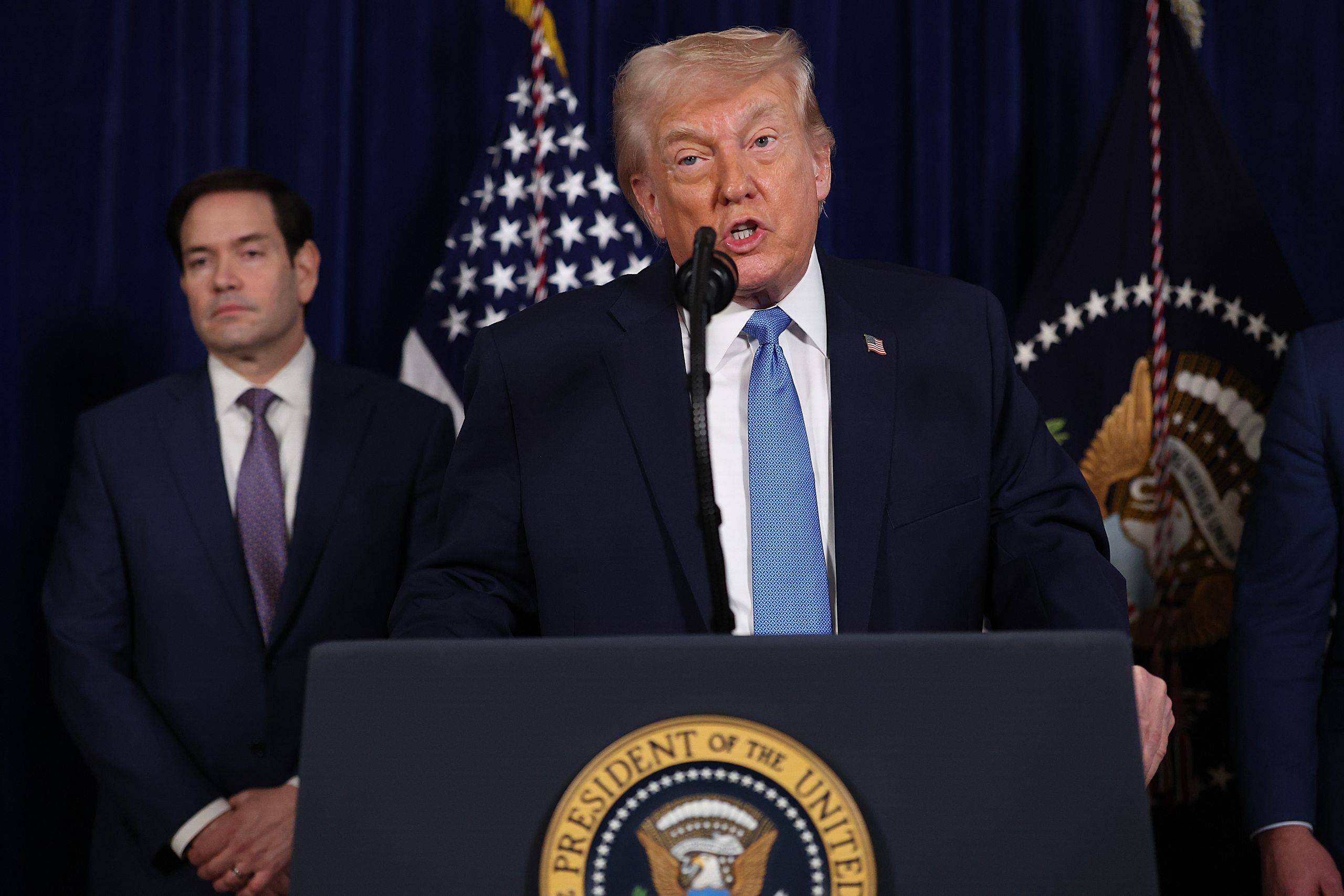
The president, who is 79, appeared exhausted. His voice was subdued and hoarse, and later in the press conference, as Chairman, Joint Chiefs of Staff Dan Caine briefed the press on the operation, he seemed to struggle to stay awake. As Trump read from a stack of papers on a podium, he deviated from the script a few times, including for one lengthy aside about crime in Washington DC, where he promised “the restaurants are open, they’re happy,” and in Los Angeles, which he complained he “got no credit for” improving the fortunes of. As Trump rambled, Secretary of State Marco Rubio stood behind him, stony faced, looking at the floor.
Trump eventually handed off to Secretary of Defense Pete Hegseth. “He effed around, and he found out,” Hegseth said of Maduro in his own short remarks. Rubio spoke next, maintaining that Maduro was “not the legitimate president” of Venezuela and noting he was indicted on drug trafficking and corruption charges in the Southern District of New York in 2020. On Saturday, the Justice Department announced new charges against Maduro and his wife, who was also captured.
No one who spoke at the press conference offered much of an explanation as to how the United States would run the large Latin American country of nearly 30 million people after deposing its president overnight.
The administration has already given contradictory statements regarding what comes next. Republican Senator Mike Lee said he was assured by Rubio that he “anticipates no further action in Venezuela now that Maduro is in U.S. custody.” Those assurances were blown up by Trump just hours later, as he told the world the US would be taking control of Venezuela.
Donald Trump, Deputy Chief of Staff Stephen Miller, CIA Director John Ratcliffe, Secretary of State Marco Rubio, Secretary of Defense Pete Hegseth, and Chairman of the Joint Chiefs of Staff General Dan Caine during the press conference.
Reporters questioned Trump on next steps. Would there be a ground invasion? “We’re not afraid of boots on the ground,” Trump said. “We had boots on the ground last night. At a very high level, actually. We are not afraid of it. We don’t mind saying it. We’re going to make sure that that country is run properly.”
Who will run the country? 'For a period of time,' Trump replied—gesturing to Rubio, Hegseth, and other U.S. officials—'the people behind me.'
One matter on which there was little ambiguity was the administration’s plan to seize Venezuelan resources. “They stole our oil,” Trump said. “We couldn’t let them get away with it.”
'Trump is deadly serious,” Hegseth added, about “getting back the oil that was stolen from us.'
Vice President JD Vance, in a post on X, said “the stolen oil must be returned to the United States.”
Protestors demonstrate in front of the White House on January 3, 2026.
The Trump administration has frequently put forth the dubious argument that Venezuela, by nationalizing its petroleum industry in the 1970s, had stolen oil from the United States by kicking out the American companies that once enjoyed access to its oil-rich lands.
Trump’s fixation on oil in his press conference Saturday calls into question the administration’s claim that the operation was carried out to bring Maduro to justice in a New York courtroom. (Not to mention, the idea that this administration cares about Maduro’s alleged drug trafficking when just last month Trump pardoned the former president of Honduras for the same crime strains credulity.)
The justification for the attack will in part determine its legality. As Trump’s chief of staff Susie Wiles noted in an interview with Vanity Fair, in defense of the strikes on boats off the coast of Venezuela the administration claimed were ferrying drugs, any attack on land would require Congressional approval. “If he were to authorize some activity on land, then it’s war, then [we’d need] Congress,” she said.
The administration’s solution to that hurdle is to maintain that Maduro is not the legitimate leader of Venezuela, but instead, in the words of Rubio, the “head of the Cartel de Los Soles; a narco-terror organization which has taken possession of a country,” who is under indictment for pushing drugs into the United States.
A woman in Krakow, Poland watches Donald Trump's address to the nation.
The attack, despite its apparent success on its own terms, was carried out with the kind of chaotic and haphazard communication typical of Trump’s presidency. As of writing, the Pentagon has yet to brief the public on the objectives or legal justification for the operation, a decision that AP reporter Konstantin Toropin described as a “complete abdication of any effort to inform the American public of what the military is doing in their name.”
When bombs were first heard over Caracas, the Pentagon directed reporters to the White House for comment. But the White House did not respond, until Trump posted a missive to Truth Social in the early hours of Saturday morning announcing that the U.S. conducted a “large scale strike” in Venezuela and “captured” Maduro and his wife. He gave further information on the operation to a New York Times reporter who cold-called him at 4:30 a.m. and more in an extensive phone interview with Fox & Friends Weekend.
Throughout the morning, Trump signalled that his ambitions to remake the Western hemisphere by force did not stop with Venezuela. “The cartels are running Mexico,” he told Fox News. “We have to do something.” At the Mar-a-Lago presser, Trump said Cuba is “very similar” to Venezuela, while Rubio said leaders in Havana should “be concerned.” The president of Colombia, Trump said, has to “watch his ass.”
It was a dizzying display that might come as a shock to those Americans who supported Trump because he promised to end foreign entanglements. “This is what many in MAGA thought they voted to end,” wrote Marjorie Taylor Greene in a scathing statement condemning Trump on Saturday. “Boy were we wrong.”
Susie Wiles, JD Vance, and the “Junkyard Dogs”: The White House Chief of Staff On Trump’s Second Term (Part 1 of 2)
Susie Wiles Talks Epstein Files, Pete Hegseth’s War Tactics, Retribution, and More (Part 2 of 2)
11 Disgusting Things From the Latest Epstein Files Drop
Vanity Fair Goes to the White House: Trump 2.0 Edition
The Children of MAGA Speak Their Minds
Donald Trump’s Reported Health Issues, Examined
Even Christians Have Had Enough of Ballerina Farm
Getting Intimate With Heated Rivalry’s Connor Storrie and Hudson Williams
Meet the 11 Best Movies of 2025
From the Archive: Behind the Mysteries of Capote’s Swans Scandal