Tradwife Debate: How Christian Communities Are Reacting to Ballerina Farm | Vanity Fair
For most of this year, Kyrie Luke has been telling her more than 72,000 YouTube subscribers that it’s time for Christian moms to renegotiate their relationship to the internet. She didn’t realize how important that advice would be until this September, when videos of Charlie Kirk’s killing rapidly began circulating online. Last month, Luke told Vanity Fair that while she never sought out footage of Kirk bleeding out, it appeared on her feeds anyway. “I was shocked, and I couldn’t sleep for days,” she says. “I was not meant to see that. I should not have seen that.”
Luke doesn’t post about the topics that would obviously put her in the Turning Point USA orbit, but Kirk and his organization’s characteristic melding of politics and faith have been so influential on the Christian internet that she was hearing commentary from her audience immediately. She films videos for the Transformed Homemakers Society, her channel and blog, from her home in Idaho, where she lives with her husband and three kids. Over the last five years, Luke has built a strong relationship with audience members, who come to her for domestic advice using principles gleaned from the Bible.
Luke is part of a wave of conservative Christian influencers whose content attempts to present a more realistic alternative to the pastoral ideal of TikTok tradwives. They’re building smaller but perhaps more engaged audiences across social media platforms, blogs, and alternative forums like Substack and Patreon. If the first tradwife era was about making the conservative lifestyle seem attractive, this new wave of influencers is trying to make it seem sustainable for women who have already chosen that path—even if retaining that audience means turning away from right-wing rage bait.
Luke started out as a basic domestic content creator, writing a recipe blog and decorating tips. “It was very surface level, talking about aesthetics and things like that,” she says. Eventually she started feeling overwhelmed by the demands of an unsustainable ideal and decided she needed to heal. “And I’m like, Is this our calling? Is this actually what God wants for us? Should women be doing this? Is this even healthy for us? This seems totally unsustainable.”
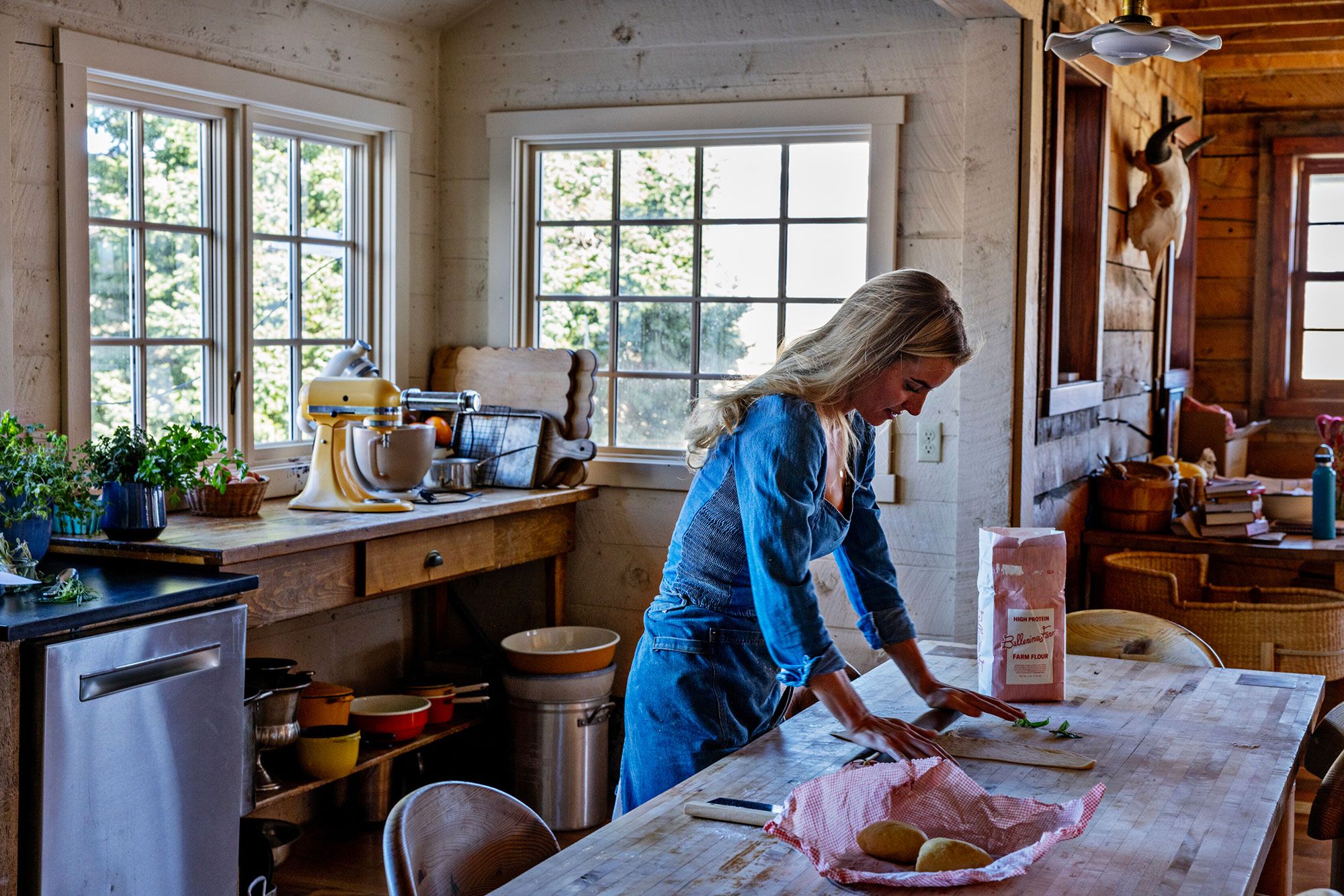
So she pivoted. Her audience, she says, “doesn’t resonate with the perfect house, the perfectly, aesthetically clean house. Nobody can afford that, really.” Luke wants them to understand that successful content creators associated with the tradwife trend, like Hannah Neeleman of Ballerina Farm, aren’t necessarily doing things the average woman can emulate—not even the average Christian woman. “Number one, they have a great aesthetic online because they can fund it. Number two, they have very particular convictions when it comes to having children.”
“Your calling does not need to look like hers,” Luke says of Neeleman. “Those are all great goals if that’s what you’re convicted on and if that is what you think is your calling. But there’s this whole other side, and that’s okay too.”
Selah Lapinskas, an influencer who posts Christian financial advice under the handle Mamas on a Budget, says she didn’t really start to find traction online until she started posting about the realities of raising kids with financial limits—pushing back against the idea that young families should always have more children than they think they can afford, one promoted by Kirk and other pronatalist pundits. “I love doing what I do, but I still am very much just a mom in her kitchen making food for her kids,” says Lapinskas, who recently announced that she is expecting her third child. “I think that a lot of women can be and are taking advantage of the opportunity right now.”
Lapinskas lives in South Carolina with her husband, a nurse who works four 10-hour shifts a week. She films videos and updates her social media accounts in between caring for her kids, and recent videos range from the obviously spiritual (“Is it a sin not to tithe?”) to the more mundane, like a series about how she spends money in the course of a single day. “I was hoping to be a voice for women and for mothers of reason, of logic, of wisdom—coupled with faith and taking risks,” she says. “Having a child is always a risk to some degree. Financially, it’s always a risk in every way.”
Lapinskas says she noticed more magical thinking coming from Christian influencers during the COVID era. “They were interpreting the prosperity gospel to say, ‘we don’t have to work hard, we don’t have to pay attention financially, everything is all faith, and there’s just no practical sides to any of it,’” she says, referring to the controversial belief that financial well-being is a sign of God’s favor. “Having a lot of babies is a beautiful thing. But a lot of people are using their children to gain followings.”
Motherhood is a strange currency in the world of online influencers; growing a family also means having a steady stream of new content. But Lapinskas points out that following this path doesn’t work for families who aren’t independently wealthy. “If they were not in a situation that was already good, it could exacerbate that,” she says. “He wants to bless us with children but he also wants us to be good stewards.” It’s not unusual to hear this critique from a secular or feminist position, but many influencers are increasingly adapting it to a Christian context, in which a rigid idea of motherhood can actually make it harder for their followers to stay devoted to their religion.
As the Donald Trump era drags on, MAGA women seem to be increasingly divided into two camps: the cosmopolitan libertines who want lower taxes, and the more traditional social conservatives. But even those in the second group have begun to find that they don’t agree on everything. And there is an inherent tension in trying to emphasize theological purity over culture-war anger, as Faith Womack—the founder of Bible Nerd Ministries—learned in the wake of Kirk’s death. Womack, who shares tips about improving Bible study habits to 290,000 subscribers on her YouTube channel, posted a video in which she tried to pull people “back to Jesus” in the aftermath of the tragedy. In hindsight, Womack says, it might have been too soon to make that type of comment.
“People were angry. They wanted me to make a very politically charged video instead of bringing everybody back to the cross,” she says. Several people in the comments made a point to tell Womack they rejected her approach to teaching the gospel and preferred Kirk’s. “That was really sad for me to read,” she says.
Womack hopes that as the first wave of online tradwives lose their novelty, people will look for more trustworthy sources. “We went through a really rocky period there where we idolized moms who had the aesthetic rather than the fruit,” Womack says. “If you are a stay-at-home mom who makes the sourdough and only homeschools, you feel like you’re better than everybody else.”
Womack can sympathize; as a younger woman, she says, “my life plan was to marry a pastor, go out to the mission field, pump out babies, make sourdough, and live the long-skirt life. Truly, as silly as that sounds, that’s what I viewed as high, holy, pious righteousness.” She started making content about her faith after experiencing a miscarriage while living in an isolated, rural area. But as time went on, she decided to get a postgraduate seminary degree.
Now her goal is to teach hermeneutics, “the study of how we read and interpret the Bible faithfully,” she says. “I’m not trying to do it for them. I'm trying to teach them how to do it.’”
As she speaks about the trouble with contemporary audiences, Womack—knowingly or not—echoes the talking points of more liberal, secular commentators. “We’re not creating people that are discipled in the faith that actually can critically think,” Womack says. “That’s the core problem. Don’t make sourdough just because it’s a trend. Don’t homeschool just because it’s a trend. Do everything with conviction. A lot of people are lazy in their faith. They want other people to think for them.”
Jennie Gage, an ex-Mormon single mother of four living in Arizona, has a striking tagline on her YouTube: “A MAN is NOT a freaking PLAN!” In videos across social media platforms, she explains that she learned this from experience. She married at 20, then took “that path of the very traditional wife—baking all of our bread from scratch.” She believed deeply that her husband and religious community would provide for her. Then she got divorced. “I lived in million-dollar homes and had a lot of security, and I had worked really hard to love my husband and love my kids and build this future for us,” she says now. “But losing my husband meant losing everything.”
She started thinking about sharing her story publicly after a counselor asked her how someone who seemed pretty smart had wound up in such a difficult situation. “I posted my first video about how I became homeless and unemployed because I had given up my future to be a tradwife,” she says. “By giving up my future career, by giving up financial stability, by giving up my name on the bank account, I was putting it all on the altar. I had one hundred percent faith that God was going to catch me if I fell.”
And she wasn’t alone. “I looked around and saw some of my girlfriends going through the same thing,” Gage says. “There’s some common denominators here. We were all Mormon. We had all gotten married really young. We had all worked as our husband’s assistants in different businesses.”
Like Luke, the Idaho-based founder of the Transformed Homemakers Society, she wanted to express a counterpoint to an internet saturated with idealized versions of motherhood—and one idealized mother in particular. “The first tradwife that I saw was Hannah Neeleman and Ballerina Farm, and I thought she was a cute little girl living in a mobile home,” Gage says. “I totally bought into the whole aesthetic of everything that she was doing.” It was only later that she realized Neeleman was married to the son of JetBlue founder David Neeleman and was also earning a hefty income through her social media following.
“The people pushing the tradwife life have never lived in poverty. They’ve never actually struggled. They don’t know what it’s like to be a woman who then loses everything,” Gage says. “The people that are selling it—the churches and the Charlie Kirks and the influencers and the TikTok tradwives—they really don’t have any idea what that looks like in the lives of everyday, working-class people.”
Gage wants to encourage homemakers and stay-at-home-mothers to put more thought into contingency planning. “Sometimes we’re a little bit misguided and we’re trusting in the system that we don’t fully understand. We don’t have all of the information just because everybody around us is doing it,” she says. “Because societally, we all feel that impact when a displaced homemaker gets divorced and becomes homeless.”
Luke, for her part, feels like she is still helping her audience through the loss of Kirk. “They watched him and gleaned his insight, and they felt like he was probably a friend,” she says. “That’s really shaken up my audience and it’s challenged their worldview, their belief, their theology, everything.”
In response, she has been telling them to avoid falling into online rabbit holes and think instead about what they can do to make their lives better. “My message is that peace is possible regardless of your circumstances. Your circumstances don’t have to improve in order for you to have peace. Peace is a gift of the spirit,” she says. And gaining it sometimes means staying offline—or “watching less tradwife content. You have to filter everything through your lifestyle.”
Meet the 11 Best Movies of 2025
The 2026 Hollywood Issue: Let’s Hear It For the Boys!
How Melania Trump Is Bringing the Christmas Spirit to the White House
Unpacking the “Atom Bomb” of the Oscar Wilde Scandal
Spend 37 Hours With Hollywood’s Power Players
See What All the Stars Wore at the 2025 Gotham Film Awards
The 19 Best TV Shows of 2025
A Brief History of Hollywood’s Sexiest, Prettiest, and Most Over-the-Top Homes
Olivia Nuzzi Returns With American Canto: Read the Exclusive Excerpt
From the Archive: Behind the Mysteries of Capote’s Swans Scandal