Designer Pierpaolo Piccioli Aims to Break Dress Codes with His New Balenciaga Collection | Vanity Fair
Last Sunday night at the 2026 Golden Globes, Tessa Thompson wore a bright green dress covered in glistening sequins by Balenciaga, designed for her by the house’s new designer Pierpaolo Piccioli, who came from Valentino. (You may recall that his debut show was attended by Meghan, Duchess of Sussex, who looked fantastic in a head-to-toe white ensemble by the designer to the delight of her fans and the chagrin of her detractors.) Thompson sparkled amongst a sea of otherwise mostly dull black and white outfits. She made this magazine’s best-dressed list for the night, and when we asked you, our readers, to vote for your favorite style moment of the evening for our new awards season leaderboard, you voted the Hedda star as your standout.
“She [looked] stunning because she was confident in what she was wearing,” says Piccioli, calling in from his office in Paris. The designer has a reputation for being contemporary fashion’s true romantic, in for both his deft use of color and the emotion with which he speaks of his designs. “This is something that we cannot underestimate, that being beautiful and being elegant has a lot to do with the way you feel,” he says.
Tessa Thompson at the 2026 Golden Globe Awards
Jonathan Bailey at the Paris premiere of Wicked: For Good
It’s this thesis around which he is building the new Balenciaga. When asked to define the look of his iteration of the house, he reverts to the community around it: “I would rather define the people that can belong to this new Balenciaga world,” he says. So far he’s most memorably dressed Thompson, Jonathan Bailey, and the musician Giveon—a well-rounded group of forward-thinking characters. “That’s how you create a kind of new Balenciaga, because when you manage a house like this, you cannot create a new world that is only made of garments,” he says. “It’s the people, the culture that blend together to become the new world of Balenciaga.”
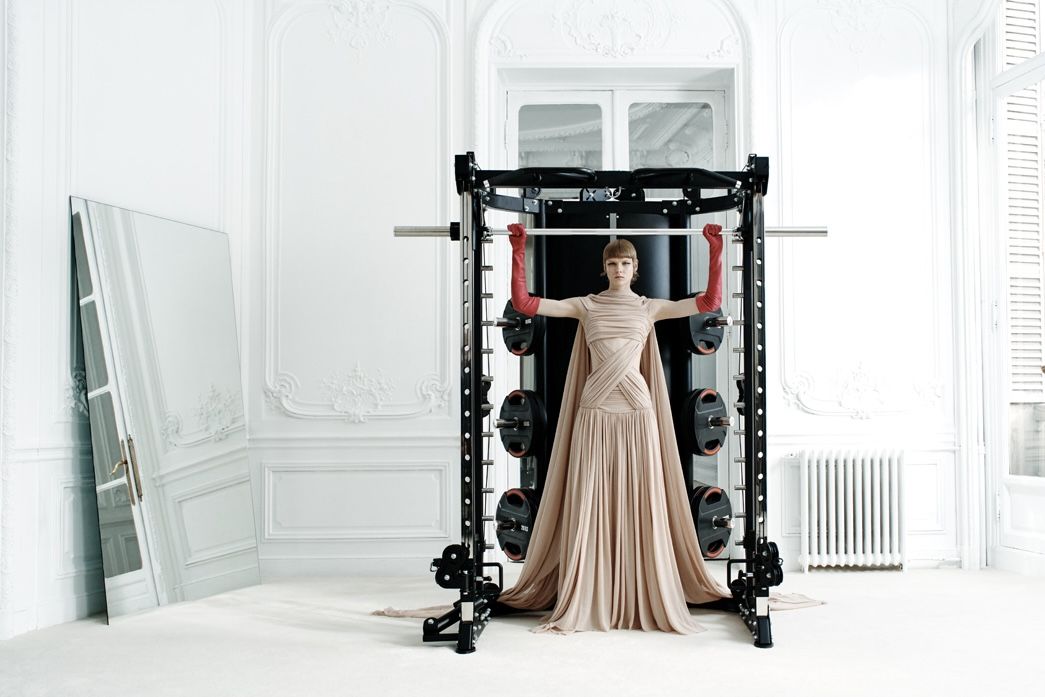
Concretely, Piccioli wants his Balenciaga to reflect a contemporary definition of beauty. His new collection, which includes red carpet-ready gowns, athletic wear, and everyday clothing, has been photographed in the Parisian metro and next to gym equipment to bring this point across. “I love the idea of melding together moments as our life is today,” he says.
Piccioli wants to do away with the idea that “heels are for ladies whose lunch or ties belong in formal dressing.” Instead, he intends to place all of his clothing at the same level so that his customer sees a pair of leggings through the same lens they’d see a sequined car coat or a jersey gown. It’s why Bailey wore a bomber jacket and a semi-sheer T-shirt to a Wicked: For Good photo call, and why this collection features partnerships with both the NBA and Manolo Blahnik—formal now means “put together” rather than “dressy.”
Balenciaga, fall 2026
Balenciaga, fall 2026
Balenciaga, fall 2026
It’s a tall order, and the collection accomplishes this to various degrees of success. A sequined car coat for your commute? Sure! Workout leggings with stilettos? Less so, and perhaps reminiscent of a pre-pandemic Kim Kardashian. Still, Piccioli has the right idea in that clothes, and the occasions for which we buy them, don’t mean what they used to. We no longer apply the “rule of thirds” when dressing or speak of “business casual” at the office and ban whites after Labor Day in the ways our parents once did. Millennials started to break down those definitions as we reached adulthood and the outbreak of COVID-19 helped bury them altogether.
Now people can buy luxury hoodies and tracksuits and find a decent suit or cocktail dress at Uniqlo or Zara—this is fashion’s new reality. And so Piccioli wants his new Balenciaga to speak to this new world order. “It’s an invitation to see garments with a sort of open-mindedness,” he says, “with the freedom to use garments as a tool to express yourself.” He wants the Balenciaga community, he says, to seek confidence in their sartorial choices, “because we try to protect ourselves in a moment where the world is not the best place to be,” he says.
Balenciaga, fall 2026
Balenciaga, fall 2026
Piccioli looked closey at the Balenciaga archives.
Winter 1966, N°28 © Photographer Thomas Kublin, Balenciaga Archives Paris
Piccioli’s clothes are engineered to feel light and easier to wear than they are at face value. It’s not only those popular Balenciaga sneakers, an invention of his predecessor Demna, that he’s made less clunky (“you can now run in them!” Piccioli says), but his ready-to-wear, be that jeans or peacoats, also feels weightless in a similar way technical athleisure does, mimicking the way Cristóbal Balenciaga made his couture lighter and more comfortable with the invention of a new fabric weave called gazar. “That is the key to a modern Balenciaga,” Piccioli says, “to have this feeling of shape and structure but with lightness, of incorporating air between body and fabric in order to get new shapes in the space.”
If Piccioli’s first show in Paris last October at times felt like it was trying to speak to too many worlds at once—with its homages to his predecessors and the house’s founder, plus his own design signatures for good measure—it’s with this collection where he’s delivered a clearer message, particularly in his menswear, which is being seen for the first time.
For men, Piccioli has designed car coats and bomber jackets with curvaceous shapes that feel true to Cristóbal’s signatures without becoming too challenging for an everyday shopper. The legs of his chinos have what he described as a “banana shape” but don’t appear clownish. “Menswear, which has been restricted for centuries with rules, is important to change from the inside,” he says, explaining that he wanted to keep a masculine feel, but with a sense of silhouette “that makes you stand out.” Just don’t call it fancy. “I hate fanciness in men. I like pieces that can stand out, but I don’t like the idea of looking like a peacock.”
The “banana-shaped” pants.
A hybrid of a tailored jacket combined with a button down shirt.
Balenciaga, fall 2026
Translating his vision into menswear has evidently helped Piccioli bridge the gap between the disparate kinds of people he is now making clothes for. On one hand, there’s the society women he courted and conquered at Valentino, who he now has to make sure to charm with his Balenciaga, and on the other there’s the Demna fanatics who fell for that designer’s oversized suiting, fashion hoodies, and other meme-worthy propositions. Demna achieved this with a dose of cynicism, a post-modern and sardonic idea of fashion that performed well under customers at first because it felt self-aware—until the world moved on from that perspective. Piccioli is betting on earnestness, and perhaps more surprisingly, wellness.
It’s acute framing, given that the new luxury is a thin body by way of personal trainers and GLP-1s, or a freshly nipped and tucked face maintained with the help of some good skincare. “Everything is melded together, tech and couture, creating a new tension, where I think lies the idea of contemporaneity,” Piccioli, a proper wordsmith, says. He then speaks more plainly: “The idea of taking care of yourself, which is wellness, is also related to the idea of couture, of taking care of something,” he says. “In that way, these worlds that look so far, can come together as one."
Cover Star Teyana Taylor on Her Breakout Year
First Look: Meet Love Story’s John F. Kennedy Jr. and Carolyn Bessette
The Roommate Scandal That Has Downtown New York Talking
Why Ashley St. Clair Is Suing Elon Musk’s xAI
RFK Jr.’s Eugenics-Coded Crusade
Autopsy Report: Inside the Murdoch Dynasty’s Final Moments
I Was Held Hostage in Panama in 1989. I Know the Real Cost of Trump’s “America First.”
The Life—and Shocking Murder—of Playboy Playmate Dorothy Stratten
Belle Burden On Her Family’s “Legacy of Infidelity”
Susie Wiles, JD Vance, and the “Junkyard Dogs”: The White House Chief of Staff On Trump’s Second Term
From the Archive: The Serial Killer and the Texas Mom Who Stopped Him