Oona Chaplin Transitions from Tree House Living to Enchanting Villain in 'Avatar: Fire and Ash' | Vanity Fair
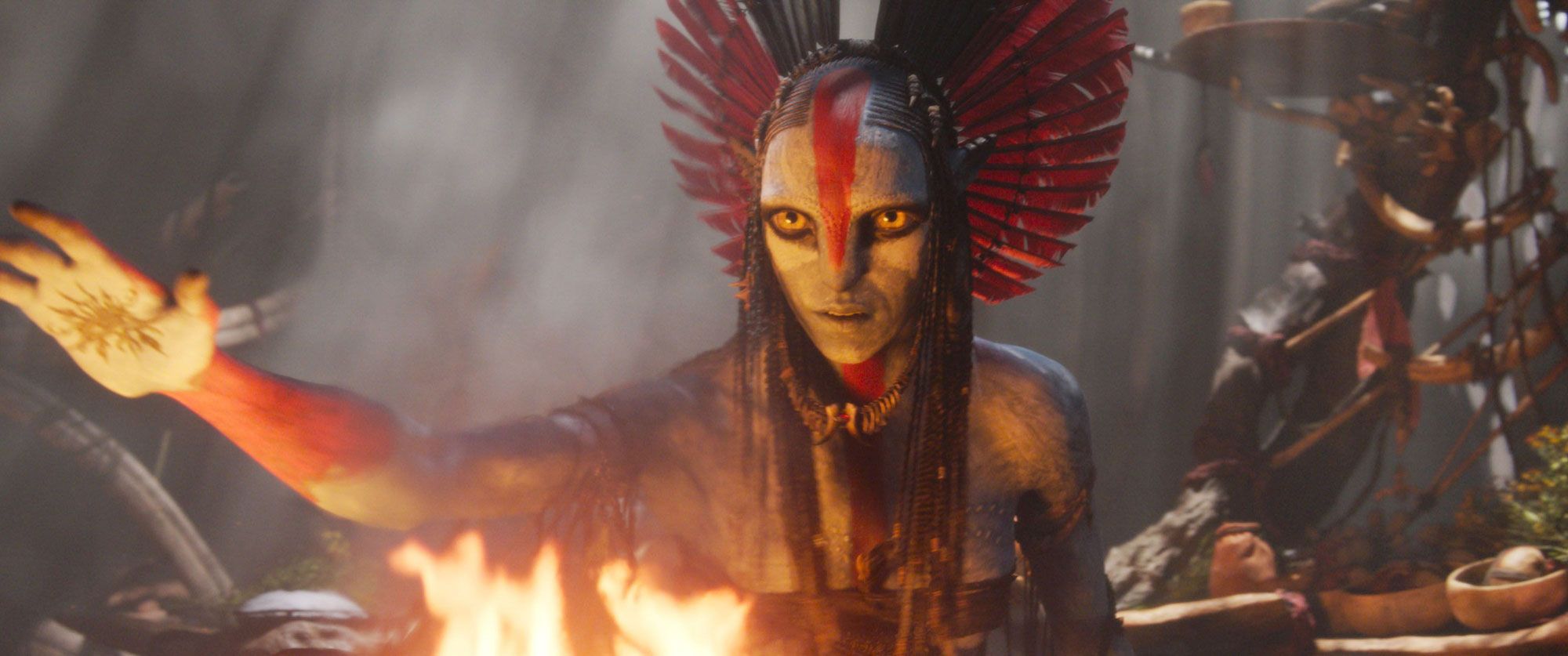
Varang, the seductive leader of the Mangkwan clan—also known as the Ash People—is the most dynamic character in Avatar: Fire and Ash. She’s physically powerful (and often wielding flaming arrows or dual blades); she’s full of rage and intensity. And she’s brought to life by Oona Chaplin, who’s best known for playing Robb Stark’s ill-fated wife on Game of Thrones—and for being the granddaughter of Charlie Chaplin, as well as the great-granddaughter of Eugene O’Neill.
But back when she first auditioned for the third film in James Cameron’s epic film series, Chaplin was as far away from the world of showbiz as she could get: living in a tree house she built herself in Cuba. “There was very, very little in this world that would’ve taken me out of the tree house. But the call from James Cameron certainly did,” she tells Vanity Fair.
Before decamping for Cuba, Chaplin had been working in the Calais Jungle—a refugee and immigrant encampment in the vicinity of Calais, France. After that incredibly difficult experience, she needed to go off the grid. “I’d gone through a little bit of a personal life crisis, and I decided to live in a tree house in the jungle in Cuba,” she says. “I built it with a couple of drunken neighbors.”
Chaplin actually shot the role in 2017, when Cameron filmed The Way of Water and Fire and Ash simultaneously. She had to spend nearly a decade keeping details about her character secret. “But because the process was so rich and fulfilling, there was a part of me that kind of put it to bed,” she says. “I was like, ‘cool. Even if the film never comes out, I’m happy.’ I feel like I accomplished and learned so much as a person, as an artist.” Since then, Chaplin has gotten married, had a child, and moved to Sonoma County, California, where she lives on a 20-acre farm with her family.
Now that Avatar: Fire and Ash is finally out, Chaplin spoke to Vanity Fair about her transformational journey, her surprising inspiration for the fiery leader, and what it’s like to carry the last name Chaplin.
Vanity Fair: How did this role come to you?
Oona Chaplin: I was flirting with some agents to see about getting signed. One of the ladies at the agency, a magnificent lady, got me a meeting with Margery Simkin, the casting director for Avatar. She put me on tape, and then a few weeks later she brought me back in to meet Jim. The process is, they lock you in a room and give you the scenes to prepare. You have as long as you need to prepare them, but you can’t take the script home. So it felt high stakes. I was terrified and nervous of meeting James Cameron—he was a hero of mine. But then I walked in, and five minutes later I’d totally forgotten about who he is because he’s just so warm and enthusiastic and childlike. We did it a couple of times, and then we just sat down and talked about permaculture and soil composition and water retention—completely nothing to do with film.
It feels sort of perfect that you were in a tree house, doesn’t it? Out of all the movies being made, there’s no movie more tied to nature than these ones.
It’s true. At the time and for the last 15 years, I’ve been devoting a lot of time and energy and resources to supporting and learning from indigenous communities from all over the world. So Avatar has been this incredible opportunity for me to braid together all of these different aspects of my life.
After you got the role, how much time was there for you to prepare?
I got it on a Thursday, and I was on a plane on a Saturday. Then we prepared for six weeks. We did some training in Hawaii and just kind of experiential living with experiences in nature, where there’s a beautiful pristine forest. I was running around the lava fields like a mad woman. And then we had just everything at our disposal: We had fight training, we had martial arts, we had archery.
Beyond the physical, where did you reach for inspiration for her emotional state?
I took a lot of inspiration from Jim. He is not evil like Varang is, but he has a very powerful word. He has an incredible way of saying “go” and having us all run in that direction fully committed, because his word carries a lot of integrity.
I obviously studied Zoe [Saldaña, who plays Neytiri]. Studying her movement, she has a very open heart and she leads from the heart where she moves. And so my center of gravity and the engine of my body kind of dropped to my pelvis, and then she started just moving like lava. It was a key that unlocked something about Varang. And then I felt very inspired by Idris Elba in [the 2015 movie] Beasts of No Nation, because he’s created a mythology around himself and it’s dark, but it’s kind of very twisted, endearing. I felt like he portrayed a leader that’s horrendous in a way that inspired a lot of compassion and confusion in me.
How tied was this film to the big changes that were going on in your personal life?
I feel like every time I’ve done a part, there’s something in my life that happens that’s around that part. There was a part of my life that I kind of did burn to the ground when I was playing Varang, and I had to learn a couple of really tough lessons in that way. I think that’s what makes me have a lot of respect for the spirit of a story. I feel like certain stories, they’re alive, and so they’re there to teach us something. It always kind of seeps through it, especially in unexpected ways.
When you were in that tree house, were you planning on not acting for a while?
I didn’t really have a plan. I just knew that I had to go and build a tree house and live in it, then see what else unfolded. Sometimes in those moments of big crisis and catharsis, you just have to give yourself the space and the place to not know. Then the next step in your path might become apparent, hopefully.
Because so much of your family has worked in this business, do you feel like that shaped a unique outlook or perspective for you in your own career?
For sure. There’s a respect for the work and it’s a job, and there’s a certain practicality and pragmatism to our approach as a family. The glitz and glamour of it doesn’t really enter the equation. Then also there’s that thing that I was saying before about stories. That doesn’t really come from my family as the teaching that gets handed down, but I think it is alive in my family. It’s important to tell stories that uplift people.
Was it ever hard to have the last name Chaplain?
Yes, I struggled with feeling like I deserve to be in drama school. I was like, “oh my goodness, these doors are getting flung open for me because of my name, and I don’t deserve to be here.” And I sabotaged a bunch of opportunities. But then there was a moment in my mid-twenties where I just suddenly realized what an enormous waste of time that was. And these things became clear: don’t worry about why these doors are opening or not. Just understand that any door that you choose to walk through, you have to walk through it in a way that is responsible. You work hard, you’re kind to people, you get to the heart of it. But at this point in my life, I’m extremely proud. The Chaplin name is a weight that I am very happy to bear.
11 Disgusting Things From the Latest Epstein Files Drop
Megyn Kelly Speaks Out on Ben Shapiro’s “Betrayal”
Exclusive: Susie Wiles, JD Vance, and the “Junkyard Dogs”: The White House Chief of Staff On Trump’s Second Term (Part 1 of 2)
Exclusive: Susie Wiles Talks Epstein Files, Pete Hegseth’s War Tactics, Retribution, and More (Part 2 of 2)
Vanity Fair Goes to the White House: Trump 2.0 Edition
Andrew Mountbatten-Windsor’s Potential Last Christmas at the Royal Lodge
The Children of MAGA Speak Their Minds
Donald Trump’s Reported Health Issues, Examined
Even Christians Have Had Enough of Ballerina Farm
Getting Intimate With Heated Rivalry’s Connor Storrie and Hudson Williams
Meet the 11 Best Movies of 2025
From the Archive: Behind the Mysteries of Capote’s Swans Scandal