Record High for Fossil Fuel CO₂ Emissions Reached in 2025
November 12, 2025
by University of Exeter
edited by Stephanie Baum, reviewed by Robert Egan
scientific editor
associate editor
This article has been reviewed according to Science X's editorial process and policies. Editors have highlighted the following attributes while ensuring the content's credibility:
fact-checked
peer-reviewed publication
trusted source
proofread
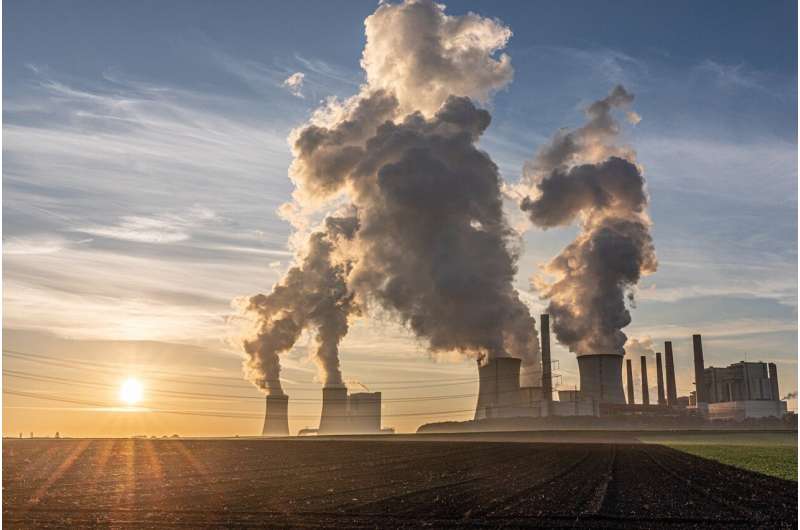
Global carbon emissions from fossil fuels are projected to rise by 1.1% in 2025—reaching a record high, according to new research by the Global Carbon Project.
The 2025 Global Carbon Budget projects 38.1 billion tons of fossil carbon dioxide (CO2) emissions this year.
Decarbonization of energy systems is progressing in many countries—but this is not enough to offset the growth in global energy demand.
With projected emissions from land-use change (such as deforestation) down to 4.1 billion tons in 2025, total CO2 emissions are projected to be slightly lower than last year.
With the end of the 2023–24 El Niño weather pattern—which causes heat and drought in many regions—the land 'sink' (absorption of CO2 by natural ecosystems) has recovered this year to the pre-El Niño level.
This year's report—published alongside a new paper in the journal Nature—examines the impact of climate change on the land and ocean carbon sinks. It finds that 8% of the rise in atmospheric CO2 concentration since 1960 is due to climate change weakening the land and ocean sinks.
The report says the remaining carbon budget to limit global warming to 1.5°C is 'virtually exhausted.'
With no sign of the urgently needed decline in global emissions, the level of CO2 in the atmosphere—and the dangerous impacts of global warming—continue to increase.
The research team included the University of Exeter, the University of East Anglia (UEA), CICERO Center for International Climate Research, Ludwig-Maximilian-University Munich (LMU), Alfred-Wegener-Institut and more than 90 other institutions around the world.
'With CO2 emissions still increasing, keeping global warming below 1.5°C is no longer plausible,' said Professor Pierre Friedlingstein, of Exeter's Global Systems Institute, who led the study.
'The remaining carbon budget for 1.5°C, 170 billion tons of carbon dioxide, will be gone before 2030 at the current emission rate. We estimate that climate change is now reducing the combined land and ocean sinks—a clear signal from Earth that we need to dramatically reduce emissions.'
Professor Corinne Le Quéré, Royal Society Research Professor at UEA's School of Environmental Sciences, said, 'Efforts to tackle climate change are visible, with 35 countries succeeding in reducing their emissions while growing their economies, twice as much as a decade ago, and important progress in reducing reliance on fossil fuels elsewhere.
'Progress is still much too fragile to translate into the sustained decreases in global emissions needed to tackle climate change. The emerging impact of climate change on the carbon sinks is worrying and stresses further the need for urgent action.'
Glen Peters, Senior Researcher at the CICERO Center for International Climate Research, said, 'It is 10 years since the Paris Agreement was negotiated, and despite progress on many fronts, fossil CO2 emissions continue their relentless rise. Climate change and variability are also having a discernible effect on our natural climate sinks. It is clear countries need to lift their game. We now have strong evidence that clean technologies help reduce emissions while being cost effective compared to fossil alternatives.'
Discover the latest in science, tech, and space with over 100,000 subscribers who rely on Phys.org for daily insights. Sign up for our free newsletter and get updates on breakthroughs, innovations, and research that matter—daily or weekly.
Professor Julia Pongratz, at LMU's Department of Geography, said, 'The reduction in land-use emissions demonstrates the success that environmental policies can achieve. Deforestation rates in the Amazon have declined and are at their lowest level this season since 2014. Yet the sweeping fires in 2024 revealed how sensitive the ecosystem remains if we don't also limit global warming.'
Other key findings from the 2025 Global Carbon Budget include:
The Global Carbon Budget report, produced by an international team of more than 130 scientists, provides an annual, peer-reviewed update, building on established methodologies in a fully transparent manner.
The 2025 edition (the 20th annual report) is published in the journal Earth System Science Data as a preprint, and will be published later as a peer-reviewed paper.
More information: Global Carbon Budget 2025, Earth System Science Data (2025).
Pierre Friedlingstein et al, Emerging climate impact on carbon sinks in a consolidated carbon budget, Nature (2025). DOI: 10.1038/s41586-025-09802-5
Journal information: Earth System Science Data , Nature
Provided by University of Exeter